
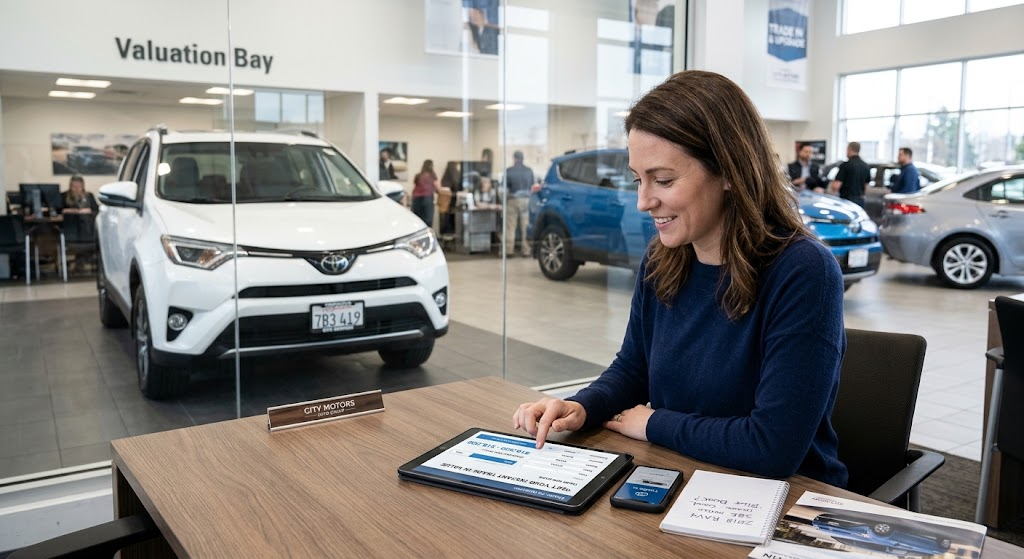
If you are asking what the trade in value on my car is, the short answer is this: it is the amount a dealer will credit you today for your current vehicle, based on what it would bring at wholesale, and it is almost always lower than what a private buyer would pay.
That gap is not automatically a bad deal. Trading in saves time, can lower your sales tax bill, and spares you the strangers, test drives, and paperwork of a private sale. This guide shows you how to get your real number, adjust it for your specific car, and run a simple math check to decide whether trading in or selling on your own puts more money in your pocket.
What Trade In Value Really Measures
Dealers do not price your car the way a shopper does. They estimate what it would fetch at a wholesale auction, then subtract reconditioning, transport, and the margin they need to resell it. That is why every valuation comes in three versions.
Retail is the highest figure, the price a dealer lists on the lot. Private party sits in the middle. Trade in is the lowest, because the dealer takes on the cost and risk of reselling your car.
Keep one thing in mind: any trade in value you see online is an estimate. The number that counts is the offer a dealer makes after looking at your car in person.
Step 1: Collect Three Numbers, Not One
Most guides tell you to check a single valuation site. One number gives you nothing to negotiate with. Collect these three instead.
- Estimated trade in value. Enter your VIN, mileage, trim, and honest condition into at least two free valuation tools, such as Kelley Blue Book and Edmunds. Use the lower result as your working estimate.
- A written instant cash offer. Request offers from online car buyers and national used car retailers. They usually ask for photos and basic details, then give an offer that stays valid for several days. This is your real floor, because someone has put a number in writing.
- Private party value. Use the same tools, but choose the private party option. This shows the ceiling you might reach by selling the car yourself.
Now you have a range instead of a guess. If a dealer’s trade in offer lands below your written cash offer, you have a clear reason to push back or simply take the cash offer.
Step 2: Adjust the Estimate for Your Actual Car
Valuation tools assume an average car, and yours is not average. Use these factors to adjust your expectations.
- Mileage compared with age. The typical driver covers roughly 12,000 miles a year. Well above that pulls value down, and well below it lifts value up.
- Condition. Be honest. Appraisers look for worn tires, dashboard warning lights, interior stains, smoke or pet odors, and mismatched paint. Very few cars truly rate as excellent.
- Accident and title history. A reported accident can reduce value even after a quality repair. Our guide to diminished value after an accident explains how much value a crash can remove. Salvage or rebuilt titles cut value sharply.
- Maintenance records. A folder of receipts proves the car was looked after. Handling the routine jobs yourself with a few basic maintenance tools makes it easier to stay on schedule and keep a clean paper trail.
- Trim, options, and color. Popular colors such as white, black, gray, and silver tend to resell faster. Features like leather seats, a sunroof, and driver assistance can help.
- Local demand. Trucks and all wheel drive vehicles tend to be in demand in snowy regions, while convertibles sell better in spring.
- Keys and manuals. A missing second key fob can cost you, because the dealer has to replace it.
The Net Advantage Formula (What Most Guides Skip)
Comparing a trade in offer to a private sale price is not apples to apples. In most states, when you trade in, you pay sales tax only on the difference between the new car price and your trade in credit. When you sell privately, you keep more cash up front, but you also spend money and time getting it. This formula puts both options on equal footing.
- Trade path value = Trade in offer + Sales tax savings
- Sales tax savings = Trade in offer x your combined sales tax rate (only where your state allows the credit)
- Sell path value = Private sale price minus selling costs
- Net Advantage = Sell path value minus Trade path value
Here is an illustration with round numbers. Your private party value is $15,000, and the dealer offers $13,200 for a trade in. With a 7% sales tax rate, your tax savings are $924, so the trade path is worth $14,124. If selling yourself costs $350 for detailing, listing fees, title paperwork, and a small repair, the sell path is worth $14,650. The Net Advantage is $526 in favor of selling.
Whether that is worth the effort is your call. Selling privately means answering messages, meeting buyers, and handling payment safely. When the Net Advantage is small, the convenience of trading in often makes up the difference. When it is large, selling on your own can pay off.
A caution: sales tax credit rules differ by state, and a few states do not offer one at all. Check your state revenue or DMV website before you count on it.
What to Fix Before Trading In, and What to Leave Alone
Dealers fix cars at wholesale cost, so your retail repair bill rarely comes back in the offer. Spend money only where it clearly pays.
Worth doing:
- Deep clean the interior and exterior, including the trunk and door jambs
- Replace burned out bulbs and worn wiper blades
- Fix small cosmetic issues you can handle for under $100
- Gather both keys, the owner’s manual, and your service records
- Remove personal items, toll tags, and saved phone connections
Usually not worth it:
- Major mechanical repairs
- Large dents or body damage
- New tires, unless the current ones are unsafe
- Aftermarket upgrades, since custom wheels and stereos rarely return what you paid, and even what window tinting costs seldom comes back dollar for dollar
If a check engine light is on, get the code read first. Many parts stores will do it for free, and knowing the cause beats being surprised at the appraisal. Do not clear the code right before the dealer looks at the car, because appraisers can often tell, and it hurts trust.
Protection such as paint protection film can keep paint in better shape and support a stronger condition rating, but it rarely pays for itself at trade in.
The Best Time to Trade In
Timing will not rescue a bad offer, but it can improve a good one. These windows often work in your favor.
- Before you cross big mileage markers such as 60,000 and 100,000 miles, when buyers tend to get more cautious
- Before your factory warranty ends, since remaining coverage is a selling point
- In spring, when used car demand tends to rise and tax refunds hit bank accounts
- Near the end of a month or quarter, when dealers push for volume
- Before your model is redesigned, since a new generation can soften prices on the older one
How to Negotiate Without Losing Track of the Math
- Settle the price of the car you are buying first. Keep the trade out of the conversation until that price is agreed in writing.
- Then introduce your trade. Show your best written offer so the dealer knows where the floor is.
- Ask for everything itemized. You want to see the new car price, the trade in credit, taxes, and fees on separate lines. A higher trade in credit means nothing if the new car price rises by the same amount.
- Be willing to walk away. You can always sell to the buyer who gave you the written offer.
- Know your payoff if you still owe money. Ask your lender for a payoff quote, which usually stays valid for about ten days. If you owe more than the car is worth, read our guide to trading in a financed car before you sign anything.
When Selling or Scrapping Beats Trading In
A few situations call for a different route.
If your car no longer runs, is very old, or has extreme mileage, a dealer may not want it. A buyer that pays cash for junk cars without a title may offer more than a trade in credit would.
If your car was totaled in a crash, your insurer pays actual cash value instead, which follows different rules than trade in value. How collision coverage pays out depends on your policy.
If your car is rare, loaded, or in unusually high demand, a private sale will usually beat any dealer offer.
Quick Checklist Before You Visit the Dealer
- Pull valuations from at least two tools and note the lower figure
- Get one or more written instant cash offers
- Look up your private party value
- Run the Net Advantage formula with your state’s sales tax rate
- Clean the car and gather keys, records, and your payoff quote
- Decide your walk away number before you arrive
Frequently Asked Questions
Is trade in value the same as Kelley Blue Book value?
No. Kelley Blue Book is one estimate among several. Any online figure is a starting point, and the dealer’s offer after an in person inspection is the number that counts.
How much lower is trade in value than private sale value?
There is no fixed percentage. The gap depends on your car’s age, demand, and condition, which is exactly why the Net Advantage formula uses your own three numbers instead of a rule of thumb.
Can I trade in a car with a check engine light?
Yes. Dealers accept cars with warning lights, but expect a deduction to cover diagnosis and repair. Getting the code read first helps you judge whether the deduction is fair.
Does cleaning my car really raise the offer?
A detail does not change the market value, but it shapes how the appraiser rates the condition and gives a stronger first impression. For a small cost, it is one of the better returns you can get.
Do I need the title with me when I trade in?
If you own the car outright, bring the title or lien release, depending on your state. If you still have a loan, the dealer can usually handle the payoff paperwork with your lender.
Final Thoughts
The trade in value on my car is not a single figure handed down by a website. It is a range shaped by wholesale demand, your car’s real condition, your state’s tax rules, and how well you negotiate. Collect three numbers, adjust for your car, run the Net Advantage math, and keep the trade separate from the purchase price. Do that, and you will walk into any dealership knowing exactly what your car is worth to you.