
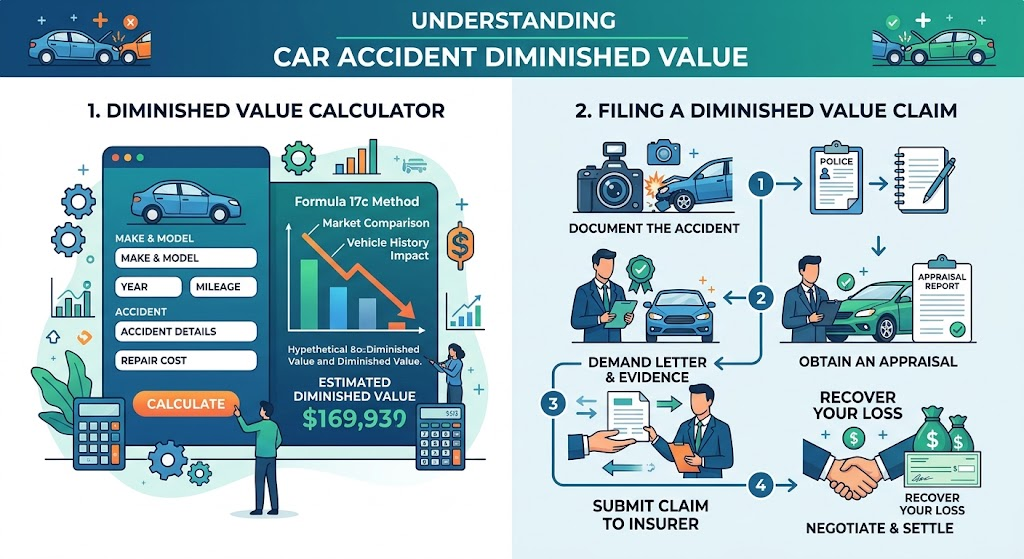
A car accident diminished value calculator estimates how much market value your car lost because of its accident history, even after perfect repairs. A repaired car with a crash on its record is simply worth less to buyers, and that lost value is something you may be able to claim.
The problem is that most free online calculators hand you a single number without explaining how it was built. That makes it easy for an insurance adjuster to wave it away. This guide shows the formula insurers commonly use, a second method based on real market prices, and how to combine the two into a figure you can actually defend.
What Diminished Value Means
Diminished value is the gap between what your car would sell for with a clean history and what it sells for now that an accident is on record. It comes in three forms.
- Inherent loss. The car has an accident history, and buyers will pay less for it no matter how good the repair was.
- Repair related loss. The repair was imperfect, for example a paint mismatch, uneven panel gaps, or parts that are not original.
- Immediate loss. The drop in value you would see if you had to sell right after the crash.
For most claims, inherent loss is the main number, and it is what the calculators below estimate.
Who Pays: At Fault Insurer or Your Own
In most states, the strongest route is a claim against the at fault driver’s insurance company, often called a third party claim. If someone else caused the crash, you can usually ask their insurer to cover the lost value on top of repair costs.
Claims against your own insurance are harder. Your own collision coverage typically pays to repair your car, not to make up for the lost resale value. A few states allow first party claims, but most do not, and a handful of states restrict diminished value claims in other ways. Check your state’s rules or ask your state insurance department before you build your case.
Method 1: The 17c Formula (Your Floor)
This formula is widely used by insurers, which makes it a useful starting point. It works in three steps.
- Set the base value. Take 10% of your car’s market value before the accident. This is the most the formula will ever allow.
- Apply a damage modifier. Multiply the base by a number from 0 to 1.00 based on how severe the damage was.
- Apply a mileage modifier. Multiply again by a number from 0 to 1.00 based on your odometer reading.
Damage modifier
- Severe structural or frame damage: 1.00
- Major damage to multiple panels or components: 0.75
- Moderate damage, such as bolted on parts replaced: 0.50
- Minor damage, such as small repairs: 0.25
- Only cosmetic or no visible damage: 0.00
Mileage modifier
- Up to 19,999 miles: 1.00
- 20,000 to 39,999 miles: 0.80
- 40,000 to 59,999 miles: 0.60
- 60,000 to 79,999 miles: 0.40
- 80,000 to 99,999 miles: 0.20
- 100,000 miles or more: 0.00
Example: Your car was worth $30,000 before the crash. The base is $3,000. The damage was moderate, so you multiply by 0.50 to get $1,500. The car has 45,000 miles, so you multiply by 0.60 to land at $900.
Treat that number as a floor, not a final answer. The formula ignores your trim level, local demand, and how popular your model is, and it often produces a lower figure than the market would.
Method 2: The Market Comparison (Your Ceiling)
This method uses real prices and is harder for an adjuster to dismiss.
- Find clean history comparisons. Collect three listings for the same year, make, model, trim, and similar mileage with no reported accidents. Average the asking prices.
- Find accident history comparisons. Look for similar listings where the history report shows a reported accident, and average those prices.
- Subtract. The difference is your market based estimate of lost value.
- Back it up. An independent diminished value appraisal, which often costs a few hundred dollars, turns your estimate into a formal report.
Example: Clean listings average $30,000 and listings with a reported accident average $27,400. Your market based loss is $2,600.
Combine Both Into a Claim Range
Now you have two figures: the formula floor of $900 and the market ceiling of $2,600. Your opening demand should sit near the market figure, backed by your comparisons. Expect the insurer to counter closer to the formula. Most settlements land somewhere in between, and having both numbers on paper keeps you from being pushed all the way down to the floor.
The Claim Strength Scorecard
Not every claim is equally strong. Answer yes or no to each question.
- Was the other driver clearly at fault?
- Is your car less than about five years old?
- Does it have under about 60,000 miles?
- Was there structural damage, frame damage, or airbag deployment?
- Did repairs cost a meaningful share of the car’s value?
Four or five yes answers suggest a strong claim worth pursuing firmly. Two or three suggest a moderate claim, where documentation matters most. Zero or one suggests a weak claim, and you may decide the effort is not worth it. This is a practical guide, not a legal test.
Build Your Evidence Folder
Adjusters respond to paperwork. Gather these before you contact anyone.
- The police report and photos of the damage
- The repair estimate and the final repair invoice
- Proof of the car’s pre accident condition, such as service records and photos
- Your comparison listings and the calculation from each method
- A vehicle history report showing the accident record
- An independent appraisal, if you got one
How to File the Claim
- Wait to sign any release. Do not sign a final settlement for the repair costs until you have discussed diminished value, because a release can close the door on further claims.
- Write a demand letter. State the amount you are requesting, show how you calculated it, and attach your evidence.
- Send it to the at fault insurer’s adjuster. Keep copies and note dates.
- Negotiate. Respond to each counter offer in writing and point back to your comparisons.
- Escalate if needed. If the offer is far too low, you can file a complaint with your state insurance department or take the claim to small claims court. For larger or contested amounts, consider speaking with an attorney.
Deadlines vary by state and are often a few years, but they can be shorter. Start soon after the repairs are complete. This is general information and not legal advice.
When Diminished Value Is Likely Small
Be realistic about the cases where this claim rarely pays off.
- Cars with very high mileage, since the mileage modifier can drop the formula to zero
- Older cars that already sell for little
- Cars with prior accident damage, since the history was already marked down
- Minor cosmetic damage with no structural repair
If You Plan to Sell Soon
An accident record shows up in the offer you get from a dealer, too. Before you sell or trade, collect three numbers instead of one, as explained in our guide to trade in value on my car. If you still owe money, our guide to trading in a financed car shows how to read your equity so the loan does not catch you off guard.
Quick Checklist
- Confirm who was at fault and which insurer should pay
- Wait for the repairs to finish and keep every invoice
- Run the 17c formula for your floor
- Run the market comparison for your ceiling
- Assemble your evidence folder
- Send a written demand before signing any release
Frequently Asked Questions
Does insurance pay diminished value automatically?
No. Insurers rarely offer it on their own. You usually have to ask in writing and support your request with evidence.
Can I claim diminished value if the accident was my fault?
Usually not from the other party’s insurer, since they are not responsible. Your own policy generally does not cover it either, though a few states allow first party claims.
Can I claim diminished value on a totaled car?
No. A total loss is paid at actual cash value, and there is no repaired car left to lose value.
How long do I have to file a diminished value claim?
It depends on your state, and the window can be as short as one or two years. Do not wait until the end of it.
Do I need a lawyer for a diminished value claim?
Not always. Many people handle smaller claims on their own with good documentation. For large or disputed amounts, an attorney can be worth the cost.
Final Thoughts
A diminished value calculator is only the first step. Use the formula for a floor, the market comparison for a ceiling, and a well organized evidence folder to bridge the gap between them. When you can show an adjuster how you reached your number, you move from asking for a favor to presenting a documented claim.