
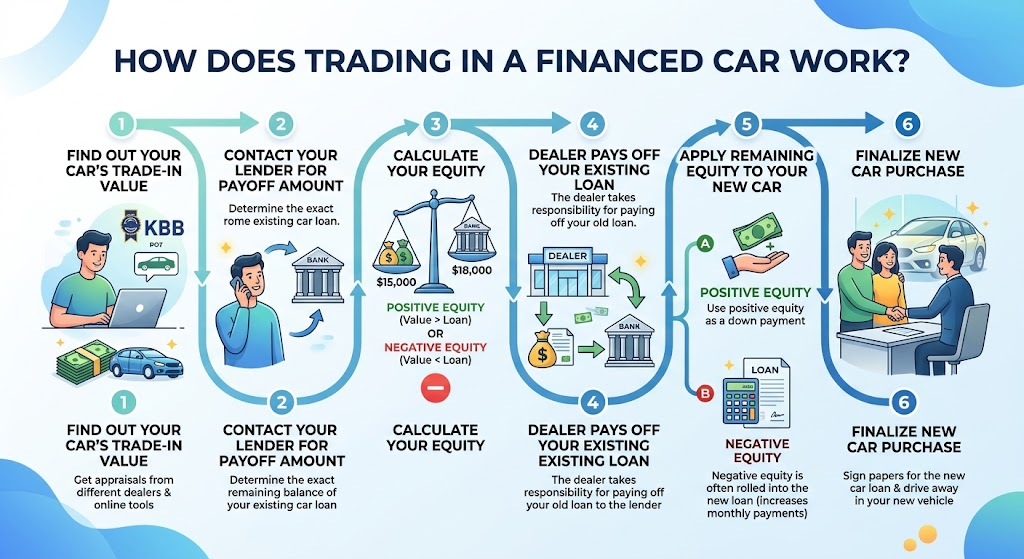
How does trading in a financed car work? In short, the dealer pays off your remaining loan balance using your car’s trade in value, and whatever is left over, positive or negative, carries into your next deal. If your car is worth more than you owe, the extra acts like a down payment. If you owe more than it is worth, the shortfall usually gets added to your new loan.
That sounds simple, and the mechanics are. The part that costs people money is not knowing their numbers before they walk in. This guide covers the exact steps, a simple Equity Scorecard to tell you which situation you are in, and a realistic look at what rolling debt into a new loan actually costs.
What Happens to Your Loan When You Trade In
When you finance a car, the lender holds a lien on it, which means the car is collateral until the loan is paid. You cannot hand over a car with a lien the way you would a paid off one. So the dealer takes over the paperwork: they appraise your car, ask your lender for the payoff amount, send that payment, and apply any difference to the car you are buying.
Your old loan ends. A new loan on the new car begins. These are two separate contracts, and keeping them separate in your mind makes every number easier to read.
Step 1: Get Your Payoff Quote, Not Your Statement Balance
The balance on your monthly statement is not the amount needed to close the loan. The payoff amount includes interest that has built up since your last payment, and sometimes fees. Call your lender or check your online account and request a payoff quote with these details:
- The total payoff amount and the date it is good through
- The daily interest amount, so you can adjust if closing takes longer than expected
- Whether the contract has any early payoff fee
- Where the payoff payment should be sent
- Who holds the title, and whether it is paper or electronic
Payoff quotes usually stay valid for about ten days. If your deal drags past that date, ask for an updated figure.
Step 2: Find Your Equity
Equity is the gap between what your car is worth to a dealer and what you owe.
Equity = Trade in offer minus Payoff amount
A positive result means you have equity. A negative result means you are upside down. The trade in offer is the figure that matters here, not the private sale price, because the dealer is the one writing the check. To get a realistic number before you visit, start with our guide to trade in value on my car, which shows how to collect three numbers instead of relying on one estimate.
The Equity Scorecard
Once you have your equity figure, find your zone. Each one calls for a different move.
Zone 1: Positive Equity (more than $500 ahead)
What it means: Your car is worth more than the loan.
What to do: Make sure the dealer credits the full amount toward your next purchase, and check that it shows up as a line item, not buried in the monthly payment. If the equity is large, compare your offer with a written cash offer from another buyer. You can also ask whether a bigger down payment lets you take a shorter loan term.
Zone 2: Near Break Even (within about $500 either way)
What it means: Trading in is simple. The sale roughly cancels the loan.
What to do: Focus your energy on the price of the new car and the interest rate. A small shortfall at this level is easy to pay in cash at signing, which keeps your new loan clean.
Zone 3: Negative Equity (more than $500 behind)
What it means: You owe more than the car is worth, so the dealer cannot cover the loan with the trade in credit alone.
What to do: You have four choices.
- Pay the shortfall in cash at the dealership
- Wait a few months and make extra payments to close the gap
- Choose a less expensive replacement car so the new loan stays manageable
- Roll the shortfall into the new loan, which is the most common choice and the most expensive
What Rolling Negative Equity Really Costs
Dealers often present rolled in debt as if it disappears. It does not. It becomes part of the amount you finance, and you pay interest on it for the entire new loan.
Here is an example with round numbers. Your payoff is $14,500 and the dealer offers $12,000 for your car, leaving $2,500 of negative equity. You buy a $28,000 car. Before taxes and fees, your new loan is $30,500, not $28,000. At a 7% interest rate over 72 months, that extra $2,500 costs you about $43 more each month and roughly $3,070 in total, which means about $570 in added interest on top of the $2,500 itself.
The bigger risk is starting the new loan already upside down. If you finance more than the new car is worth, any early drop in value leaves you owing more than the car again. A rule of thumb: try to keep your new loan close to or below the car’s actual value.
If you do roll debt into a new loan, ask about GAP coverage. It pays the difference between what you owe and what the car is worth if the car is totaled. It works alongside collision coverage, which pays the car’s actual cash value but may not cover the full loan balance.
Step 3: Watch the Deal Structure, Not Just the Payment
Many dealers steer the conversation toward a monthly payment. That makes it easy to hide negative equity by stretching the loan term. Before signing, ask to see these figures on paper:
- The total amount financed
- The interest rate and loan term
- The trade in credit as a separate line
- The payoff amount being sent to your old lender
- All taxes and fees
Then compare the total amount financed with the price of the car. If the amount financed is much higher, find out exactly what was added.
What Happens After You Sign
Signing is not the finish line. Use this timeline to protect yourself.
- Keep making payments on the old loan until you have written confirmation. The dealer is responsible for paying off your lender, but timing varies and delays do happen. A missed payment can hurt your credit.
- Expect the payoff within a couple of weeks. Rules differ by state, but most dealers send the payment promptly.
- Check your lender account. It should show a zero balance and a closed status.
- Request proof of payoff. Keep the paid in full letter and the lien release or title confirmation.
- Review your credit report after a month or two. The old loan should show as closed with a zero balance.
If your old lender still shows a balance after the expected window, call the dealer and the lender right away and keep records of every conversation.
Special Situations
Your loan is with a bank or credit union, not the dealer. That is fine. The dealer works with any lender and simply requests the payoff amount.
You have a co signer. Expect the co signer to be involved, since they are also tied to the loan.
You are behind on payments. Trading in is still possible in some cases, but your options narrow and the paperwork gets harder. If you are worried about keeping the car at all, read about what happens to your car if you file for bankruptcy before making a decision.
You are leasing instead of financing. Leases follow different rules than loans. This guide covers financed cars only.
Quick Checklist Before You Trade In
- Request a payoff quote and note its expiration date
- Gather a realistic trade in value from more than one source
- Calculate your equity and find your Scorecard zone
- Decide whether you will pay any shortfall in cash
- Ask about GAP coverage if you will finance more than the car is worth
- Keep paying your old loan until payoff is confirmed in writing
Frequently Asked Questions
Can I trade in a car if I owe more than it is worth?
Yes. The shortfall can be paid in cash or rolled into the new loan. Rolling it in is allowed by most lenders, but it raises your total cost and can leave you upside down again.
Will trading in a financed car hurt my credit?
A new loan application usually causes a small, temporary dip from the credit inquiry and the new account. Missed payments during the transition cause far more damage, so keep paying until payoff is confirmed.
Do I need my lender’s permission to trade in a financed car?
You do not need to ask permission, but the lender must receive a full payoff before releasing its lien. The dealer will request the payoff quote, though getting your own beforehand gives you a number to work with.
How long does it take for the dealer to pay off my old loan?
It depends on the dealer, the lender, and your state, but it commonly takes a few days to a couple of weeks. Confirm the payoff in writing instead of assuming it happened.
Is it better to sell privately when I still owe money?
It can be, if the sale price clears your loan, but the process is more complicated because the lender holds the title. You will need to coordinate payoff with the buyer.
Final Thoughts
Trading in a financed car is less mysterious than it looks. Get your payoff quote, calculate your equity, find your zone on the Scorecard, and read every figure on the deal sheet before you sign. If you stay in control of the numbers, the loan on your old car stops being a problem and becomes just one more line on the page.