
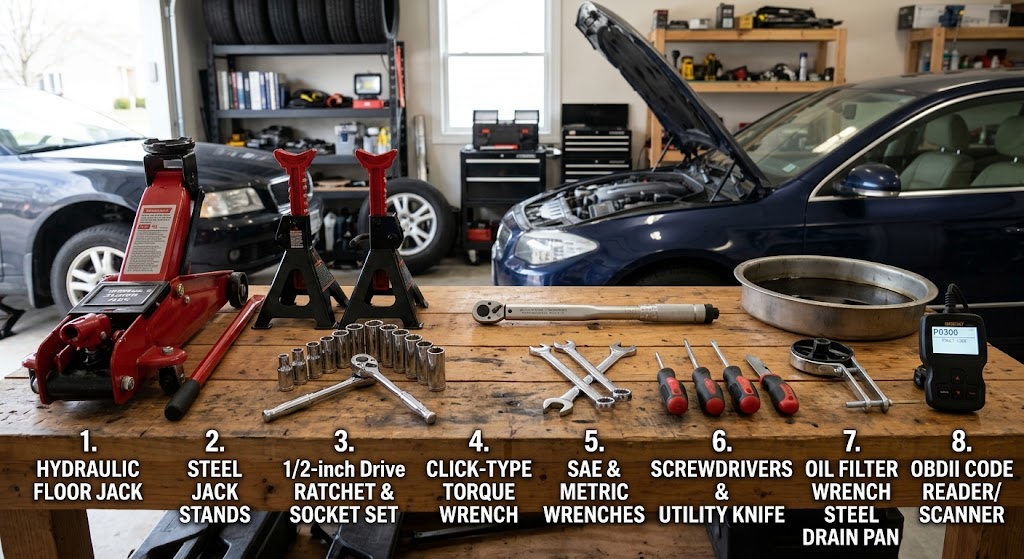
You do not need a full garage to maintain your own car. A small set of vehicle repair tools covers oil changes, brake jobs, wheel work and basic diagnosis. Here are eight essentials, what each is used for, and what to buy first.
What to buy first
If you are starting from zero, buy in this order: jack stands, a socket set, a torque wrench and an OBD2 scanner. Those four cover the most common jobs and keep you safe.
1. Socket and ratchet set
A good set with both metric and SAE sizes, in 1/4 inch and 3/8 inch drive, handles most bolts under the hood and under the car. Choose six point sockets, which grip bolts better than twelve point sockets and are less likely to round them off. Add a few extensions and a universal joint for tight spots.
2. Torque wrench
Wheel nuts, brake caliper bolts and many engine parts have exact torque specs. Too loose is dangerous, and too tight can stretch bolts or warp parts. Look up the figure in your owner’s manual and set the wrench to it. A click type 1/2 inch wrench is a common starting point for lug nuts. If you are also replacing tires, our Tire 101 guide to the best tires for trucks explains how to choose the right size and type.
3. Floor jack and jack stands
A floor jack lifts the car, but it is not designed to hold it. Always support the vehicle on jack stands rated above its weight, on level ground, and never work under a car held only by a jack. This is the most important safety purchase on the list. Regular maintenance also helps prevent the mechanical failures that cause car accidents.
4. OBD2 scan tool
Every car sold in the US since 1996 has an OBD2 port. A basic scanner reads the codes behind a check engine light and can clear them after a repair. It tells you where to start, not what to replace, so research each code before buying parts. Our [vehicle diagnostic tool guide] covers what to look for in a scanner.
5. Oil change tools
You need a drain pan, a funnel and an oil filter wrench that fits your filter. A drain plug socket or the correct wrench helps avoid stripping the plug. Add a torque wrench to tighten the plug and filter to spec.
6. Brake tools and cleaner
A brake caliper piston tool pushes or winds back the piston when you fit new pads. Many rear calipers must be rotated, not pushed, so check your car’s procedure first. Brake cleaner removes dust and grease from rotors and calipers. Use it in a ventilated space, wear gloves and eye protection, and keep it away from flames. Never get brake fluid or cleaner residue on pad friction surfaces.
7. Breaker bar, penetrating oil and heat gun
Rusted bolts are the most common reason a simple job stalls. A long breaker bar gives leverage that a ratchet cannot. Soak the bolt in penetrating oil first. WD40 is a water displacer and light lubricant, and a dedicated penetrating oil usually works better on seized fasteners. A heat gun can help loosen stubborn thread locker or corroded hardware, but keep it away from fuel lines, wiring and rubber parts.
8. Tap and die set
A tap cuts or cleans internal threads, and a die does the same for external threads. They are useful for repairing damaged bolts and holes. Use a thread gauge to identify the size before you buy or cut, and know that a badly damaged thread may need a repair insert instead.
Quick reference
| Tool | Used for | Priority |
|---|---|---|
| Socket set | General repairs | Buy first |
| Torque wrench | Wheels, brakes, engine parts | Buy first |
| Jack and jack stands | Getting under the car safely | Buy first |
| OBD2 scanner | Check engine light codes | Buy first |
| Oil change tools | Oil and filter changes | Early |
| Brake tools and cleaner | Pad and rotor jobs | When needed |
| Breaker bar and penetrating oil | Seized bolts | Early |
| Tap and die set | Thread repair | Later |
Tips before you start
- Read the repair procedure for your exact car before you begin.
- Buy quality for tools that carry load or safety weight, such as jack stands and torque wrenches.
- Keep your tools organized so you do not lose small sockets.
- Know your limits. If a job involves airbags, fuel systems or complex electronics, a professional is the safer choice.
FAQ
What tools do I need for basic car maintenance?
A socket set, torque wrench, floor jack, jack stands, OBD2 scanner and oil change tools cover most routine jobs.
What should I buy first for a vehicle tool kit?
Jack stands, then a socket set and a torque wrench.
Do I need an OBD2 scanner?
It is very useful for any car built after 1996, since it reads the codes behind a check engine light.
Is WD40 good for rusted bolts?
It helps, but a dedicated penetrating oil usually works better.