
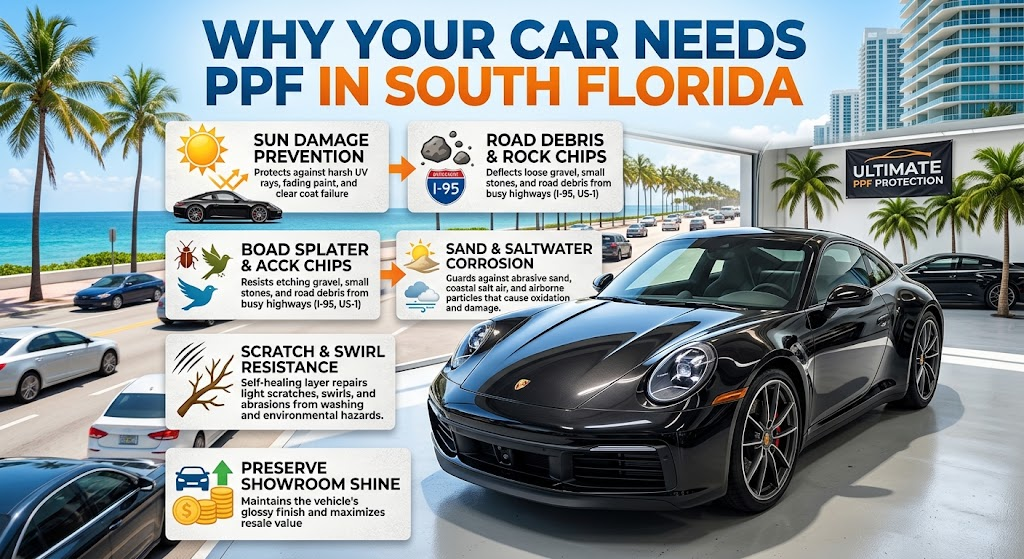
South Florida is great for drivers and brutal on paint. Between Miami, Fort Lauderdale, and Palm Beach, your car deals with intense sun, salty air, daily storms, and a long list of things that leave marks. Paint protection film, usually called PPF, is a clear urethane layer applied over your paint to absorb that damage so your clear coat does not.
This guide explains why your car needs PPF in South Florida, what it actually protects against here, what it costs, and how to pick an installer who understands local conditions.
What PPF Actually Does
PPF is a transparent, flexible film that sits on top of your paint. It takes the hit from rock chips, scratches, and stains. Most quality films also have a top coat that helps light scratches disappear with heat from the sun or warm water, and that makes washing easier.
It is not the same as wax or ceramic coating. Wax and ceramic add gloss and water beading. PPF adds a physical barrier, which is why it is the only option that really stops rock chips.
The South Florida Threat Map
Most PPF articles are written for every climate at once. Here is what is specific to our region.
Relentless UV and heat. The sun here is strong almost all year. UV breaks down clear coat over time, leading to fading, dull spots, and peeling. Dark colors also absorb heat, which stresses paint further.
Lovebugs. Twice a year, usually around May and again around September, swarms of lovebugs splatter across front bumpers, hoods, mirrors, and windshields. Their bodies are acidic, and if left on hot paint they can etch into the clear coat in a matter of days. PPF keeps that acid off the paint, so you can wash it away instead of polishing out a permanent mark.
Salt air and humidity. If you live or drive near the coast, salt in the air settles on your car and speeds up corrosion on any chipped area. Constant humidity also keeps contaminants on the surface longer.
Sudden downpours and hard water spots. Afternoon storms leave behind mineral deposits as water dries quickly in the heat. Left alone, those spots can etch into paint.
Road debris and construction. South Florida roads are busy and always under construction. Sand, gravel, and debris on the interstate and major roads cause constant chips, especially on the front bumper, hood, and mirrors.
Bird droppings, tree sap, and palm debris. In the heat, these bake onto paint quickly and can leave stains or etching.
Crowded parking lots. Tight garages and shopping center lots mean door dings, cart marks, and scuffs, especially around door edges and rear bumpers.
Why Ceramic Coating Alone Is Not Enough
Ceramic coating is a good product, and many South Florida owners use it. But it is a thin chemical layer. It helps with gloss, UV resistance, and easier washing, yet it does not stop a rock from chipping your paint.
The strongest setup for many owners is PPF on high impact areas with ceramic coating over the film and the rest of the car. You get impact protection and easier maintenance together.
Where to Apply PPF
You do not have to wrap the whole car. Common packages include:
- Partial front: Front bumper, part of the hood, and part of the fenders. A budget friendly starting point.
- Full front: Full bumper, full hood, full fenders, mirrors, and headlights. Popular for daily drivers.
- Track pack or high impact pack: Full front plus rocker panels, door edges, and areas near the rear wheels.
- Full body: Every painted panel. Best for new luxury, exotic, and dark colored vehicles that you plan to keep.
What Does PPF Cost in South Florida?
Prices depend on the vehicle, film brand, coverage, and installer skill. As a rough guide:
- Partial front: about $1,000 to $2,500
- Full front: about $2,000 to $3,500
- Full body: about $5,000 to $8,000 or more
These are typical ranges, so always get an itemized quote for your exact vehicle. The cheapest quote is rarely the best one, because poor cutting and edge work can cost more to fix than a proper install.
Is PPF Worth It? Think in Terms of Return
Consider what it protects:
- Resale value. Clean, original paint often brings a stronger price, and buyers notice chips and etching.
- Lease returns. Paint damage can mean extra charges at turn in.
- Repaint avoidance. A quality repaint on a modern vehicle can cost a lot, and it can lower value if the car no longer has factory paint.
- Less maintenance. Bugs, sap, and spots wash off more easily.
If you plan to keep your car for years, or if it is new, dark, or expensive, PPF often makes financial sense.
Questions to Ask Before You Book (What Many Shops Skip)
Use this checklist to compare installers properly:
- Which film brand and which exact product line do you use? Ask for the warranty in writing.
- Does the warranty cover yellowing, staining, cracking, and peeling in a hot climate? Not all do.
- Is the install done in a clean, controlled bay? Dust and humidity ruin installs.
- Do you use pre cut patterns or cut by hand? Both can work. Ask how they handle edges and avoid cutting into your paint.
- Do you wrap edges, or leave visible seams? Wrapped edges look cleaner and resist lifting.
- How do you prep the paint? Proper decontamination, and correction if needed, matters a lot.
- Can I see recent work on cars like mine? Look at edges, corners, and bumper curves.
- What are the aftercare instructions? A good shop gives clear cure time and washing guidance.
Caring for PPF in South Florida
- Wait for the full cure period before washing, as your installer instructs.
- Wash regularly, especially during lovebug season, and do not let bugs sit.
- Use pH balanced car soap and soft microfiber towels.
- Avoid harsh pressure washing close to edges.
- Park in shade or a garage when you can to reduce heat and UV exposure.
- Add a ceramic coating or a compatible film sealant for easier cleaning.
Common Myths
“PPF turns yellow.” Older or low grade films could yellow. Modern quality films are built to resist it, which is why the brand and warranty matter.
“It looks fake.” A good install on a clean car is nearly invisible.
“My car is new, so it doesn’t need it yet.” New paint is the best time to protect it, before chips and etching start.
“Garage kept cars don’t need it.” You still drive on the road, where chips and bugs happen.
Final Thoughts
If you are asking why your car needs PPF in South Florida, the answer comes down to this: our climate and roads attack paint from every direction. UV, lovebugs, salt air, sudden storms, and constant road debris all add up. PPF gives you a physical barrier that other products cannot, and when installed by a skilled shop, it protects both your car’s look and its value.
Start by deciding how much coverage fits your budget, ask the right questions, and choose an installer who can show quality work and stand behind it.
FAQ
How long does PPF last in South Florida?
Quality films often last around 5 to 10 years, depending on the product, how the car is parked, and how it is cared for. Check the warranty terms for hot climates.
How long does installation take?
Partial and full front packages often take 1 to 2 days. Full body installs can take several days.
Can PPF be removed?
Yes. A professional can remove it without damaging factory paint when it was installed and removed properly.
Does PPF protect against lovebugs?
It helps a lot. The film takes the acid exposure instead of your clear coat, and bugs wash off more easily. You should still clean them quickly.
Can I put PPF on a used car?
Yes, but paint prep matters. Existing chips and swirls may need correction first so they do not get sealed under the film.