
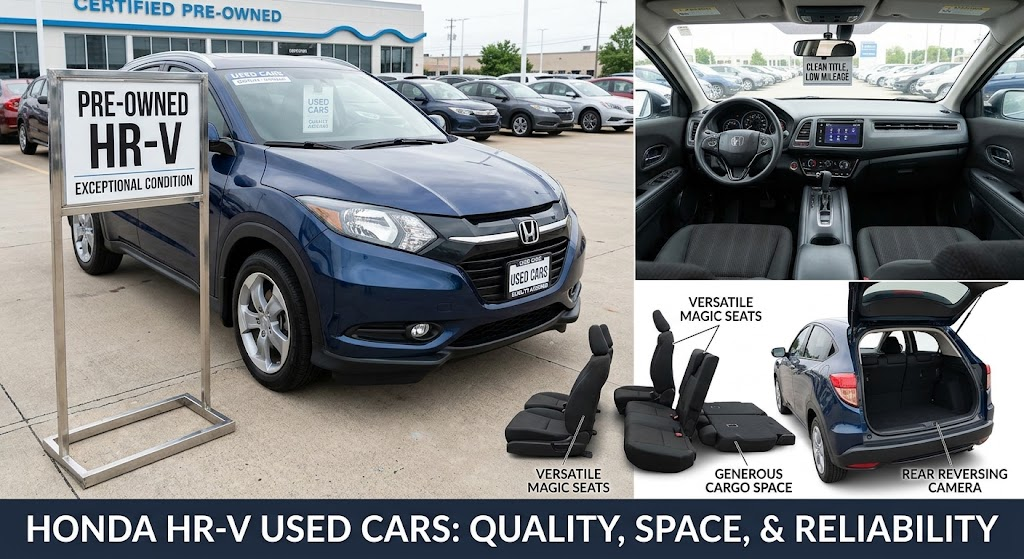
Honda HRV used cars can be a smart buy for anyone who wants a small SUV with flexible cargo space, easy running costs, and a reputation for lasting. The catch is that not every model year is equal. Owners and reliability trackers tend to treat the first model year as the roughest, and a few later years have specific issues worth checking. This guide shows you how to choose the right year, what to inspect, and what to avoid before you hand over any money.
Rankings of best and worst years differ from source to source, so treat this as a framework and always verify the specific car by its VIN.
Honda HRV Generations at a Glance
First generation, 2016 to 2022. A subcompact SUV with a 1.8 liter four cylinder engine that makes roughly 141 horsepower. Most come with a CVT automatic, front wheel drive or all wheel drive, and a few early cars offered a manual. The standout feature is the Magic Seat, a rear seat that folds and flips for unusually flexible cargo room.
Second generation, 2023 and newer. Larger, with a 2.0 liter engine making roughly 158 horsepower and a more modern interior. It costs more used, but it feels more refined on the road.
The Model Year Decision Map
Think of shopping in three lanes, each with its own trade off.
Lane 1: Budget (2016 to 2018)
These are the cheapest, and they carry the most risk. The first model year is the one owner complaint data flags most often, with reports ranging from paint quality to transmission and seating complaints. If you shop here, buy on condition and records, not price alone. Insist on proof of CVT service and a clean history report.
Lane 2: Sweet Spot (2019 to 2022)
Late first generation cars are often considered the best value, because early kinks had time to be corrected and prices have dropped. Some owners report infotainment freezing on 2019 to 2022 cars, so test the screen carefully. Check for completed recalls and software updates.
Lane 3: Late Model (2023 and newer)
Newer, bigger, and more expensive. The 2023 model year has drawn some owner complaints, including a rear glass issue that Honda addressed with a service campaign. If you look at a 2023, ask whether any rear glass work was done. Later years generally score better as early problems were fixed.
Common Problems to Check
- CVT behavior. Look for shuddering, hesitation, or whining. Ask for records of CVT fluid changes and any software updates.
- Infotainment glitches. Screens that freeze, reboot, or fail to pair with phones have been reported on some years.
- Paint quality. Early production cars show chips and peeling on some examples. Walk around the car in daylight.
- Air conditioning. Run it on full cold and listen for noise or weak cooling.
- Open recalls. Enter the VIN in the federal recall lookup. Some model years have multiple recalls.
- Seat comfort. Some owners find the seats uncomfortable on long drives, so sit in the car for more than five minutes.
Test Drive Checklist
- Start the car cold and listen for unusual noises
- Accelerate gently from a stop and feel for shudder or hesitation
- Merge at highway speed to test the engine under load
- Brake firmly in a safe place and watch for pulling or vibration
- Test the screen: pair a phone, use navigation, and cycle through menus
- Run the A/C and heat
- Flip the Magic Seat and check every latch and fold position
- Check every window, lock, light, and camera
- Look for uneven tire wear, which can hint at alignment or suspension issues
Before You Buy: History and Price
- Get a vehicle history report. Check for accidents, title problems, and odometer issues. An accident on the record lowers value even after repairs, as we explain in our guide to the car accident diminished value calculator.
- Ask for service records. CVT fluid changes and regular oil changes matter more than a low odometer reading.
- Compare three similar listings. Match year, trim, drivetrain, and mileage before judging whether a price is fair.
- Pay for an independent inspection. A trusted mechanic can spot leaks, worn parts, and past repairs in about an hour.
What It Costs to Own
The HRV is generally affordable to run. It gets good fuel economy for its class, parts are easy to find, and maintenance is straightforward. The one cost to plan for is CVT fluid service at the interval in the manual, since skipping it is a common cause of trouble in used cars.
Who Should Buy and Who Should Skip
Buy it if you want a practical small SUV with a flexible rear seat, good fuel economy, and a name known for lasting.
Skip it if you want quick acceleration, since the first generation engine is modest, or if you want a large third row or towing capacity.
If the HRV is not quite right, look at the 2021 Mazda CX 3 for a sportier feel in a similar size, or the 2022 Toyota Corolla Cross if you need more space.
Resale Value
Hondas tend to hold value well, which helps when you sell or trade the car later. Keep your service records organized, since they support a better offer, and see our guide to trade in value on my car when you are ready to sell.
Quick Checklist
- Choose your lane by budget and risk tolerance
- Verify the VIN for open recalls
- Ask for CVT service records
- Test the screen, A/C, and Magic Seat
- Get a history report and an independent inspection
- Compare three similar listings before you negotiate
Frequently Asked Questions
Is a used Honda HRV reliable?
Generally yes, especially when you choose a well maintained example. The best results come from cars with documented CVT service and completed recalls.
What is the best year for a used Honda HRV?
Opinions vary, but many buyers target the late first generation years, 2019 to 2022, or a newer second generation car if the budget allows. The first model year, 2016, is the one most often flagged.
How many miles can a Honda HRV last?
With regular maintenance, many Honda owners report reaching high mileage, often beyond 150,000 miles. Records and care matter more than the number on the odometer.
Does the HRV come with all wheel drive?
Yes, all wheel drive was offered on many trims. Confirm the drivetrain on the specific car you are looking at.
Is the HRV good in snow?
With all wheel drive and a good set of tires, it handles light snow well. Tires matter as much as the drivetrain.
Final Thoughts
A used Honda HRV rewards careful shopping. Pick your lane, verify the VIN, check the CVT history, and test the features that tend to cause trouble. Do those things, and you can get a practical small SUV that is easy to live with for years.