
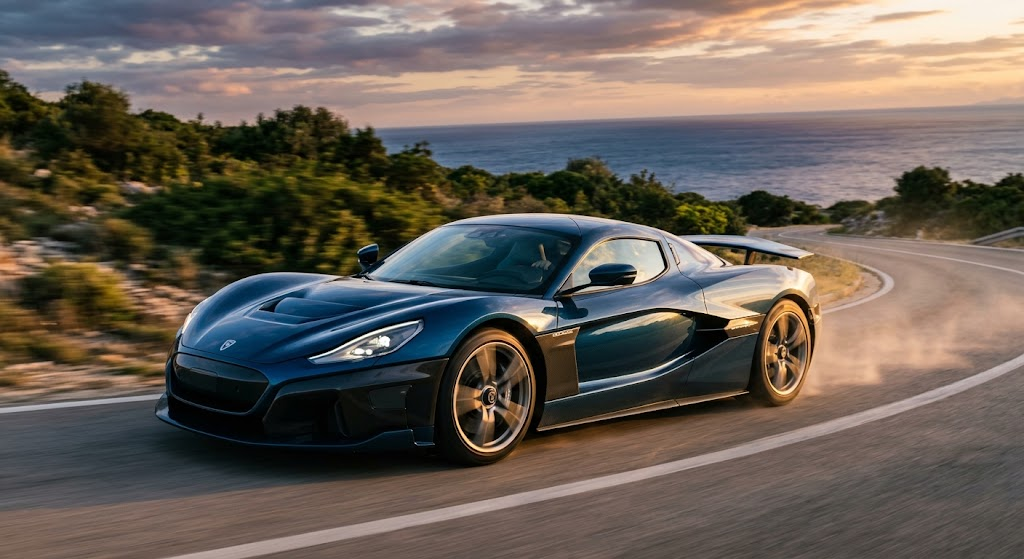
The Rimac C_Two looks like a straight line machine on paper. It has 1,914 horsepower, a claimed top speed of 258 mph and a sprint to 60 mph in under two seconds. Yet Rimac has shown it sliding sideways like a rear wheel drive sports car. That mix of brute force and control is what makes this Croatian hypercar so interesting, and it is the reason the C_Two deserves more than a spec sheet.
What Is the Rimac C_Two?
The Rimac C_Two was revealed at the Geneva Motor Show in 2018 as the second car from Rimac Automobili. It was planned as an all electric grand tourer, a car fast enough for a race track and comfortable enough to drive across a country. Production was limited to 150 units, and the company later gave the road going version a new name, Nevera. If you see both names online, they describe the same project at different stages.
Rimac also positioned the C_Two against other electric hypercars such as the Lotus Evija and the Pininfarina Battista. Those cars chase big numbers too, but the C_Two stood out for how it delivers power to the road.
Rimac C_Two Specs at a Glance
| Item | Figure |
|---|---|
| Power | 1,914 hp (1,408 kW) |
| Torque | 2,300 Nm |
| Motors | Four, one at each wheel |
| Battery | 120 kWh |
| 0 to 60 mph | Under 2 seconds (claimed) |
| 0 to 186 mph (300 km/h) | About 11.8 seconds (claimed) |
| Top speed | 258 mph (412 km/h) |
| Range | About 404 miles (650 km), claimed |
| Production run | 150 cars |
Why the Rimac C_Two Can Drift
Most electric cars with big power still behave like all wheel drive cars. They grip, they pull, and they stay tidy. The C_Two is different because each wheel has its own motor. The front motors use a single speed gearbox, while the rear motors use a two speed gearbox, which helps with both launch and high speed pull.
Because every wheel is driven separately, the car’s software can decide exactly how much torque goes to each corner. This is called torque vectoring. In a drift, the system can send more power to the outside rear wheel to push the tail out, then reduce it and shift torque forward to catch the slide. A human driver on a tight road does the same thing with throttle and steering, but the computer can adjust far faster than a foot can.
This is the core idea that most articles skip. The drift is not a party trick added to a fast car. It is a direct result of how the drivetrain is built.
Rimac C_Two Price
The C_Two was priced at around 2.1 million dollars before options, and buyers who added extras paid several hundred thousand more. The 150 cars were reported as sold out within weeks of the Geneva reveal. That means a “2020 Rimac C_Two price” today is not a showroom figure. Any car that appears on the market would be priced by private sale or auction, not by Rimac.
How to Get the Rimac C_Two in Forza Horizon 4
If a seven figure price is out of reach, the game version is the easy way in. The C_Two arrived in Forza Horizon 4 with Update 10 in June 2019, first as a seasonal reward car. After a later update the game renamed it the Rimac Concept Two.
Today you can usually get it in one of two ways:
- Buy it or bid on it through the Auction House.
- Redeem a pass at the Horizon Backstage area.
The exact method can change with game updates, so check the in game menus for the current option. Once you own it, try it on a dirt road or a wet track. The game does a fair job of showing how that per wheel power delivery changes the way the car turns.
Rimac C_Two FAQ
How much is the Rimac C_Two?
About 2.1 million dollars before options, with all 150 cars reported as sold.
How do I get the Rimac C_Two in FH4?
Through the Auction House or by redeeming a pass at Horizon Backstage.
Is the Rimac C_Two the same as the Nevera?
The Nevera is the name given to the road going production version of the C_Two project, so some figures and details differ between the two.
Is the Rimac C_Two really all wheel drive?
Yes. Four motors drive all four wheels, which is exactly why it can control a slide so precisely.
Final Thoughts
The Rimac C_Two proves that electric power can be playful as well as fast. Its numbers grab attention, but the real story is the four motor layout that lets software steer the car’s behavior one wheel at a time. That is what turns a quick hypercar into a drifting one.