
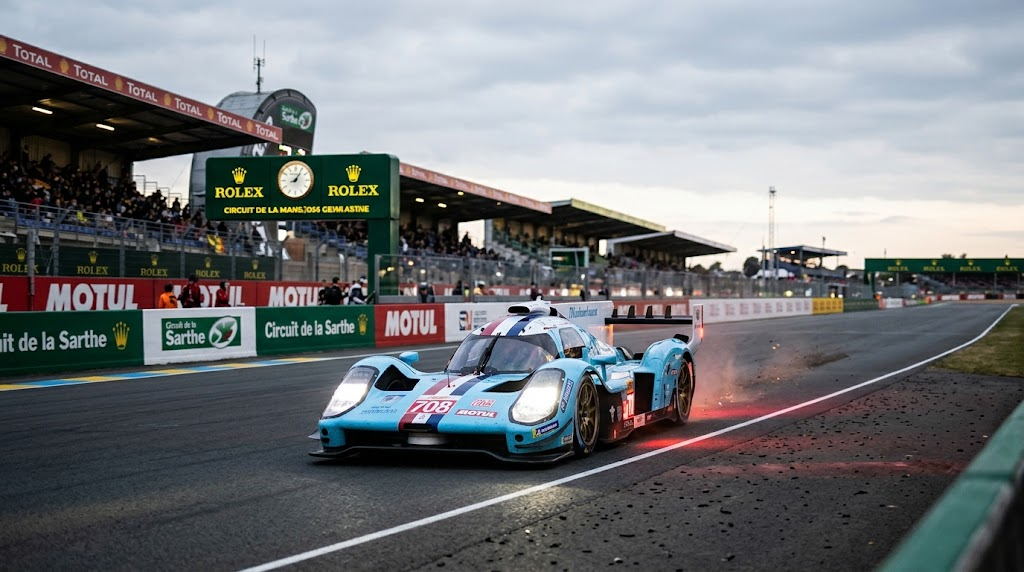
When Scuderia Cameron Glickenhaus first put its 007 on track at Monza, the sound of the twin turbo V8 told you what the new top class of endurance racing was about. The Le Mans Hypercar rules were created to make the sport cheaper, closer and more exciting after the manufacturer exits that ended the old LMP1 era. The Glickenhaus 007 was one of the first cars built to them, and it arrived from a small American privateer rather than a giant factory team.
What Is a Le Mans Hypercar?
A Le Mans Hypercar, often shortened to LMH, is a prototype race car built for the Hypercar class of the FIA World Endurance Championship and the 24 Hours of Le Mans. The rules were designed to keep top level performance while cutting costs, and to bring race cars closer to road cars. Teams could enter hybrid or non hybrid designs, and the class later opened to LMDh cars from the IMSA side so more manufacturers could take part.
The key rules for an LMH car are:
- Peak power is held to about 500 kW, which is roughly 670 horsepower, with Balance of Performance adjustments used to keep different designs close.
- Hybrid cars can add an electric front axle limited to 200 kW.
- Development budgets were capped at about 20 million euros under the original plan.
- Manufacturers were expected to build road going cars with a similar powertrain concept to the race car.
How Fast Is a Le Mans Hypercar?
Because power is capped, Hypercars are slower than the old LMP1 cars, but they are still very quick. On the long straights at Le Mans they reach roughly 205 mph, and a lap of the 8.5 mile Circuit de la Sarthe takes roughly three and a half minutes. The aim was never to set outright records. It was to create close racing between many different car designs. If you want to see what outright speed looks like in an electric road car, take a look at the Rimac C_Two.
Glickenhaus 007 LMH Specs
| Item | Detail |
|---|---|
| Engine | 3.5 liter twin turbo V8, built by Pipo Moteurs |
| Power | About 671 hp (500 kW) |
| Hybrid system | None, the first non hybrid car in the class |
| Chassis | Built with Joest Racing |
| Aerodynamics | Developed with Sauber |
| Road version | 007S, with a 6.2 liter V8 and about 1,000 hp |
The partnerships mattered. Pipo Moteurs is best known for engines in World Rally Championship cars. Joest has a long record of building winning prototypes for manufacturers such as Audi and Porsche. Sauber brought aerodynamic experience from its sports car history.
How Much Does a Le Mans Hypercar Cost?
A race ready Glickenhaus 007 was offered for just under six million dollars, and the team said a full season of racing could cost more once drivers, spares and tires were counted. The road legal 007S was announced with earlier price targets between 2.1 and 2.9 million dollars, and a total of 24 cars were planned. The latest version of the road car arrived with a 1,000 hp V8, 737 lb ft of torque and a weight of about 3,417 pounds, though a firm final price has not been widely confirmed. For another limited, track focused road car, see the Mercedes-AMG GT Black Series P One Edition.
What the Glickenhaus 007 Actually Achieved
The 007 proved the privateer idea worked better than many expected:
- It finished fourth overall at the 2021 6 Hours of Monza, one of its first races.
- It took pole position at Monza and at Spa.
- At the 2022 24 Hours of Le Mans it finished third and fourth overall.
That third place was the first overall podium for an American built car at Le Mans since the Ford GT40 in 1969. The team’s WEC program ended after the 2023 season, and it did not appear on the full 2024 entry list.
Why the Hypercar Class Matters Today
The Hypercar class now includes cars from Toyota, Ferrari, Porsche, Peugeot and others, with the Ferrari 499P winning at Le Mans in 2023, 2024 and 2025. Ford and McLaren have announced plans to join the class from 2027, which shows the rules did what they were meant to do and attracted new manufacturers.
Glickenhaus sits in the story as the car that proved a small team could challenge big brands at the front of the grid.
Le Mans Hypercar FAQ
What is a hypercar in Le Mans?
It is the top class of prototype race car, limited to about 500 kW of power and balanced so different designs can race closely.
How fast is a Le Mans Hypercar?
Roughly 205 mph on the long straights, with lap times around three and a half minutes at Le Mans.
How much does a Le Mans Hypercar cost?
Race cars cost several million dollars. The Glickenhaus 007 was offered for just under six million dollars.
Did the Glickenhaus 007 win Le Mans?
No. Its best result was third and fourth overall in 2022.
Can you buy a road version?
Yes. The Glickenhaus 007S is a road legal car based on the race car, with about 1,000 hp.
Final Thoughts
The Le Mans Hypercar class was built to bring cost and complexity under control while keeping the spectacle of endurance racing. The Glickenhaus 007 showed what that could mean in practice, a small American team with a bespoke V8 standing on the podium at Le Mans. Even after its factory program ended, the car remains one of the clearest examples of what the rules were designed to achieve.