
Mitsubishi Lancer Evo Black: Factory Colors, Paint, Wraps and a Buyer’s Guide
A black Mitsubishi Lancer Evo is a classic combination. The Evo’s wide stance, big wing, and aggressive vents look sharp in black, and the color hides the car’s age better than almost any other. But “black Evo” can mean many things: a factory black car, a repaint, a vinyl wrap, a peelable dip, or even an experimental ultra black coating.
This guide explains which Evo generations came in black, what each finish option costs and how long it lasts, what to check when you buy one, and why the original idea behind this page, an orange to black dip on an Evo, is a good example of the options.
Prices, values, and import rules change. Verify details with a specialist and the relevant agencies before you buy.
The Short Answer
- Factory black Evos exist, including the Evo X in Phantom Black Pearl.
- The 2015 Final Edition was offered in four colors in the US (Pearl White, Rally Red, Mercury Gray, and Octane Blue), with a black painted roof, so it did not come in a full black body.
- Only three Evo generations were sold new in the US: the Evo VIII (2003), Evo IX, and Evo X (2008 to 2015).
- Evo IV, VI, and some VII models are Japan market, right hand drive cars, and can be imported once they pass the 25 year rule.
- Finish options: factory paint, repaint, vinyl wrap, liquid dip, or novelty ultra black paint. Each has very different cost and durability.
Which Mitsubishi Lancer Evos Came in Black?
Evo X (2008 to 2015, US): The most common black Evo for US buyers. The factory color is Phantom Black Pearl.
Evo VIII and IX (US): Black was offered, but color names and codes differ by year. Always verify the paint code on the door jamb or VIN plate.
Evo III (JDM): Pyrenees Black is a well known color from the earlier Japanese cars, famous in anime and rally culture.
Final Edition (2015, US): Not available in black. Dark chrome and black accents, but body colors were white, red, gray, or blue.
If a seller says “factory black” on a Final Edition, check the build sheet carefully, because the car may have been repainted.
Black Mitsubishi Lancer Evo by Generation
Evo 4 black and Evo 6 black: These are Japan market cars, right hand drive only, with the 4G63 turbo engine. They are popular imports, and the Evo VI is now old enough to import under the 25 year rule.
Evo 7 (2001 to 2003), including 2002 models: Another Japan market, right hand drive generation. Eligibility depends on the exact build date, and examples are becoming importable month by month.
2003 Mitsubishi Lancer Evolution (Evo VIII): The first Evo sold new in the US, with left hand drive and a 4G63 turbo engine making about 271 horsepower. High mileage examples still sell for well over $25,000.
Evo 9 (2006 to 2007): The refined version, with MIVEC variable valve timing and about 286 to 287 horsepower. Only about 8,200 reached the US, so clean, unmodified cars are scarce.
Evo 10 black (2008 to 2015): The final generation, with an all aluminum 4B11 turbo engine, S AWC all wheel control, and about 291 horsepower in GSR form. The Final Edition makes 303 horsepower, with 1,600 built.
How Do You Import an Evo? The 25 Year Rule (What Most Guides Skip)
Many people searching for a black Evo 4 or Evo 6 are really asking whether they can legally own one. In the US, vehicles that were not originally sold here generally need to be at least 25 years old to be imported without special qualification.
- Evo IV, V, and VI: Eligible now.
- Evo VII: Becoming eligible, depending on exact build date.
- Evo VIII, IX, and X (USDM): Sold new here, so no import needed.
- Always check: The manufacture date on the VIN plate, state registration rules, and emissions requirements.
Use a reputable importer who handles paperwork, and never buy a car without confirming it can be titled in your state.
The Black Evo Finish Chooser
If you want a black Evo and do not have a factory black car, here are your options.
1. Factory black paint. Best for value and originality. Look for a clean, unrepainted car with original paint documented in records.
2. Full repaint. Best durability and finish, but also the most expensive, and it can reduce collector value if the Evo was originally another color.
3. Vinyl wrap. Fully reversible and protects the original paint underneath. Quality varies by installer, and black shows swirls and dust easily.
4. Liquid dip (peelable coating). A cheaper, removable option. A popular example is the orange to black “Hypershift” dip that gave this page its original topic, and one video put a full car order at a little over $1,100 at the time. Prices have likely changed.
5. Novelty ultra black paint. Dramatic, but not practical (see below).
A simple rule: if the car is original and valuable, protect the paint with a wrap, not a repaint.
The Orange to Black Evo That Started This Page
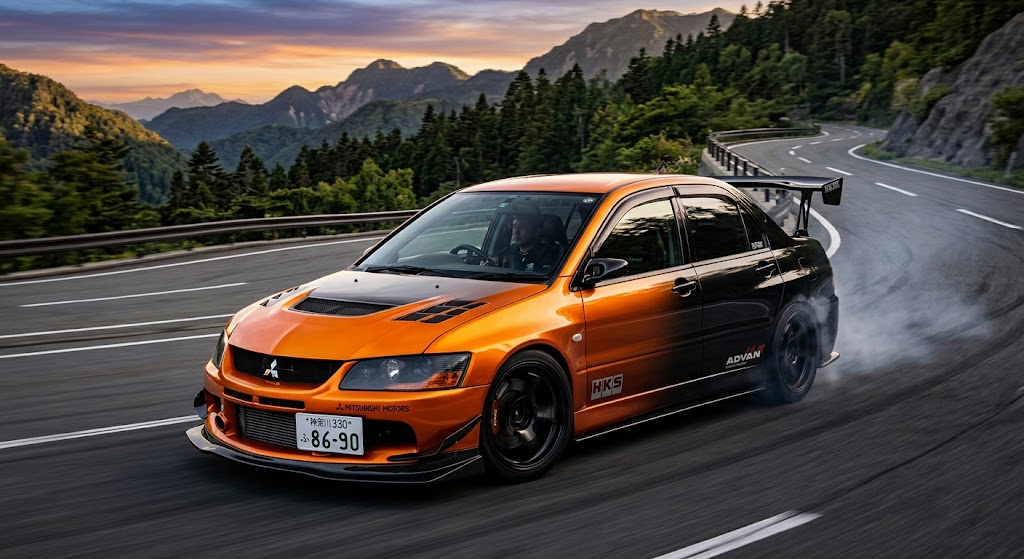
The YouTube channel DipYourCar once applied a color shifting dip called ZBO to an Evo. It fades from vivid orange to black depending on the light and the angle. Black wheels helped balance the strong orange flake. The video’s lesson for owners: a dip lets you try a bold look without permanent paint, and you can remove it later.
The caution is that color shifting finishes are polarizing, and a poor application can look patchy.
Ultra Black Paint on an Evo: Cool, but Not Road Ready
The same channel also applied Musou Black, a Japanese acrylic paint that absorbs about 99.4 percent of visible light, to a Lancer Evolution X. The result looks like a black hole: body lines vanish, and only the glass, wheels, and lights stand out.
Important facts:
- The paint is water based and very delicate. It can gloss or peel with light contact.
- It was not designed for cars, and it will not survive weather or washing well.
- A bottle costs only about ¥2,500 (roughly $18 to $24), so it is a cheap experiment, but the labor and prep are heavy.
- A car this dark is hard for other drivers to see at night, which is a safety concern.
Treat it as a show car stunt, not a daily driver finish. Show car builds can go even further, such as the Orochi with a wide body kit from Japan.
How to Keep a Black Evo Looking Good
- Wash with the two bucket method and soft microfiber towels.
- Avoid automatic car washes with brushes.
- Use a ceramic coating or paint protection to reduce swirls and make washing easier. For help choosing, see our guide to ceramic coating, PPF, and wraps.
- Park in shade or a garage to protect from UV and heat.
- Fix chips quickly, because black makes stone chips obvious.
- Use a quality quick detailer for dust.
Black Mitsubishi Lancer Evo for Sale: What to Check
Evos are popular with modifiers, so many have had hard lives. Before you buy:
- Verify the generation and trim by VIN, and confirm the color code.
- Ask about modifications. A tuned car can be fun but riskier, and unmodified cars are more valuable.
- Check the history. Look for accident, track use, and title issues.
- Look for repaint evidence if it is advertised as factory black.
- Inspect the drivetrain. Boost leaks, clutch wear, transfer case noises, and on Evo VIII and IX the active yaw control pump are worth checking.
- Check the transmission. Most US Evos have manual gearboxes, and Evo X cars may have the dual clutch automatic, which needs proper fluid service.
- Check for rust and underbody damage.
- Ask for service records, especially timing belt, fluids, and turbo work.
- Get a pre purchase inspection from a shop that knows Evos.
How Much Is a Black Evo Worth?
Values depend on generation, mileage, and originality.
- Evo VIII: High mileage examples often sell above $25,000.
- Evo IX: Clean, original cars have been reported in the $35,000 range or higher.
- Evo X: Often the most realistic way to buy an Evo under about $40,000, though the Final Edition can cost close to that or more.
- JDM imports (Evo IV and VI): Prices vary widely by condition and import costs.
Color can affect desirability, but condition and originality matter more. Check recent sold prices before you buy. If you would rather buy new with a similar rally spirit, the GR Yaris hot hatch is the closest modern equivalent.
Final Thoughts
A Mitsubishi Lancer Evo in black can be factory original, a careful repaint, or a reversible wrap or dip. Choose the finish that fits the car’s value: protect a rare original, and experiment on a modified car. Verify the generation and import status, check for repaint and hidden damage, and get a specialist inspection. The result can be one of the best looking cars in the Evo family.
FAQ
Did the Evo X come in black?
Yes. The factory color was Phantom Black Pearl.
Did the 2015 Final Edition come in black?
In the US, it was offered in Pearl White, Rally Red, Mercury Gray, and Octane Blue, with a black painted roof.
Can I import an Evo 4 or Evo 6?
Generally yes, once they meet the 25 year rule, and with proper paperwork.
Which Evos were sold new in the US?
The Evo VIII, Evo IX, and Evo X.
How much horsepower does an Evo make?
About 271 in the VIII, 286 in the IX, 291 in the X, and 303 in the Final Edition.
Is a dip or wrap better than a repaint?
A wrap or dip is reversible and protects original paint. A repaint is permanent.
Can you paint a car with Musou Black?
You can, but the paint is fragile and not designed for road use.
How much is a used Evo?
Prices vary widely, from the mid $20,000s to $40,000 or more depending on generation and condition.