
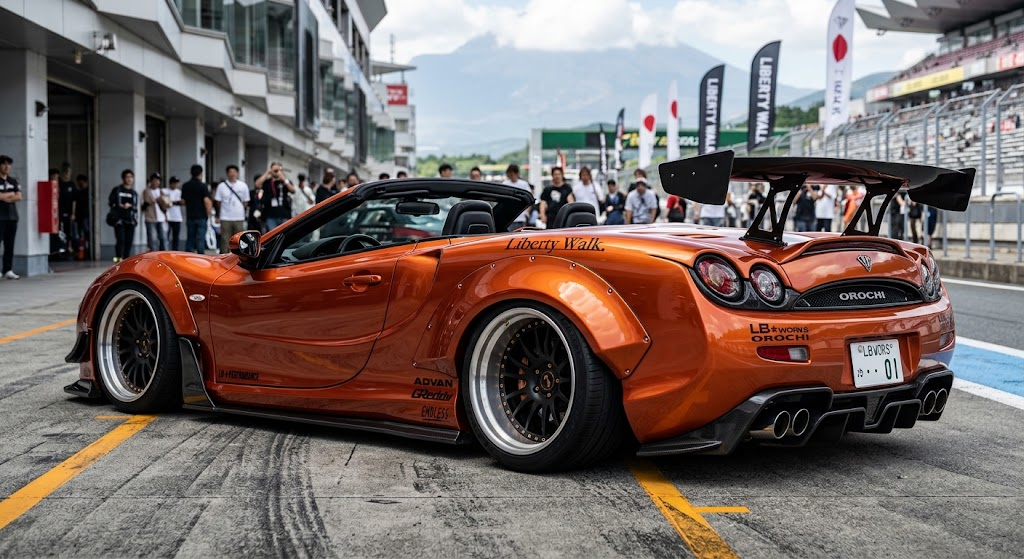
The Mitsuoka Orochi has always looked like nothing else on the road. It is long, low and shaped like a startled fish, with scissor doors and a face you either love or struggle to look at. Then Liberty Walk, the Japanese tuner famous for wide fenders and giant wings, got its hands on one. This article covers what the Mitsuoka Orochi Liberty Walk build changes, what it does not, and whether the result works.
Quick verdict
The Liberty Walk kit makes the Orochi look more purposeful, more cohesive and far more dramatic. It does nothing for performance, because the engine is untouched. If you want a head turning Japanese oddball, it is a big improvement. If you want a real supercar, it is still a styling exercise.
What is the Mitsuoka Orochi?
The Mitsuoka Orochi is a mid engine two seat sports car from Mitsuoka, a small Japanese company better known for retro styled cars based on mainstream models. It is named after Yamata no Orochi, an eight headed serpent from Japanese folklore. The concept appeared in 2001, and the production car went on sale in 2006 and continued until 2014. Special versions followed, including the cheaper Orochi Zero, the Kabuto and the Gold Premium.
Mitsuoka Orochi specs
| Spec | Detail |
|---|---|
| Engine | 3.3 litre Toyota V6 (3MZ FE) |
| Power | About 231 hp |
| Torque | About 242 lb ft |
| Gearbox | 5 speed automatic |
| Layout | Mid engine, rear wheel drive |
| 0 to 60 mph | About 7 seconds |
| Weight | Just under 3,500 lb |
| Body | Carbon fiber panels over a steel structure |
The engine is the same family used in several Toyota and Lexus models. The Orochi is reported to use underpinnings derived from the Honda NSX and shares some Honda and Lexus parts, which is part of why it is such a curious mix. Performance was always modest, closer to a relaxed grand tourer than a supercar.
What Liberty Walk changed
Liberty Walk unveiled its Orochi at the Tokyo Auto Salon in 2022. The work focuses on stance and styling.
| Area | Change |
|---|---|
| Body | Wide fender flares front and rear, extended side skirts |
| Front | Larger front splitter that sits very close to the ground |
| Rear | Tall rear wing mounted high on the bumper |
| Stance | Lowered ride height, likely with air suspension |
| Wheels | Wide black wheels filling the arches |
| Lighting | Aftermarket headlights from Sphere Light, who partnered on the project |
| Graphics | A bold lightning bolt style design along the side |
What did not change
As far as is known, the engine is unmodified. That means the car still has about 231 hp from the 3.3 litre V6 and the same 5 speed automatic. The look says race car, but the numbers are still those of a calm cruiser. Some fans joke that it deserves a bigger Toyota V8, but nothing like that has been announced. For a build that backs up its looks with real power, see the 800 horsepower Jimco Reaper.
Does it look better?
For most people, yes. The original Orochi had flowing shapes that never quite agreed with each other. The wide body kit pulls the design together. The extra width gives the car a planted stance, the splitter and wing add purpose, and the black wheels sharpen the look. It is still unusual, and Liberty Walk kits are polarizing by nature, but this one makes the Orochi look intentional. If a bold look without a body kit is more your style, the color shifting Lancer Evo shows how far paint alone can go.
Is it a good car?
Be honest about what the Orochi is. It was never a fast or sharp handling sports car, and many reviewers were harsh about it when it was new. Its appeal is rarity, styling and the story. With the Liberty Walk treatment, that appeal grows, but the driving experience remains relaxed. Treat it as a collector’s oddity, not a track weapon.
How many Mitsuoka Orochi are there?
Mitsuoka planned a limited run of about 400 cars, and the often repeated figure is 400. The exact number actually built and sold is not clearly documented, and most were built to order. It is one of the rarest Japanese cars of its era.
How much does the Mitsuoka Orochi cost?
New, the Orochi was priced at about 10.5 million yen in Japan, and a figure of roughly US$125,000 was quoted for overseas interest at the time. Today, they rarely appear for sale, and asking prices vary widely depending on condition, edition and location. A modified example like the Liberty Walk car has no public price, as it is a show build.
Is the Mitsuoka Orochi banned in America?
It was never sold new in the US, and it does not meet US federal standards. In general, cars that are not US compliant can only be imported once they are 25 years old, so even the earliest 2006 cars will not qualify until the early 2030s. That is why you rarely see one in the US. Import rules are complex and change, so check with a qualified importer before buying any foreign car.
Mitsuoka Orochi for sale
Used Orochis are very rare, mostly in Japan, and they sell through specialist dealers and auctions. If you are looking for one, check carefully:
- Confirm the edition and build details.
- Inspect the carbon fiber panels for cracks and repairs.
- Check the electrical systems and scissor door mechanisms.
- Review service history, especially for the Toyota V6 and transmission.
- Ask about parts availability, which can be difficult for a low volume car.
Pros and cons
Pros
- Unique design with real rarity
- Reliable Toyota V6 and automatic
- Scissor doors and carbon fiber body panels
- The Liberty Walk kit makes it look far more striking
Cons
- Performance is modest
- Parts and service can be hard to find
- Limited availability and complicated import rules
- The look is not for everyone
Frequently asked questions
What engine does the Mitsuoka Orochi have? A 3.3 litre Toyota V6 making about 231 hp.
Did Liberty Walk tune the engine? Not as far as is known. The changes are to the body, stance and lighting.
How rare is it? Planned production was 400 cars.
How fast is it? About 7 seconds from 0 to 60 mph.
Can you buy a Liberty Walk Orochi kit? Liberty Walk has shown one finished car. Check with the tuner for any kit availability.
Final word
The Liberty Walk Mitsuoka Orochi proves that even the strangest car can look cool with the right treatment. It is still the same relaxed Toyota powered coupe underneath, but it now looks as wild as its name suggests. As a piece of Japanese car culture, it is wonderfully ludicrous. If you would rather see a tuned car that adds speed as well as style, take a look at the supercharged Blazer from Lingenfelter.