
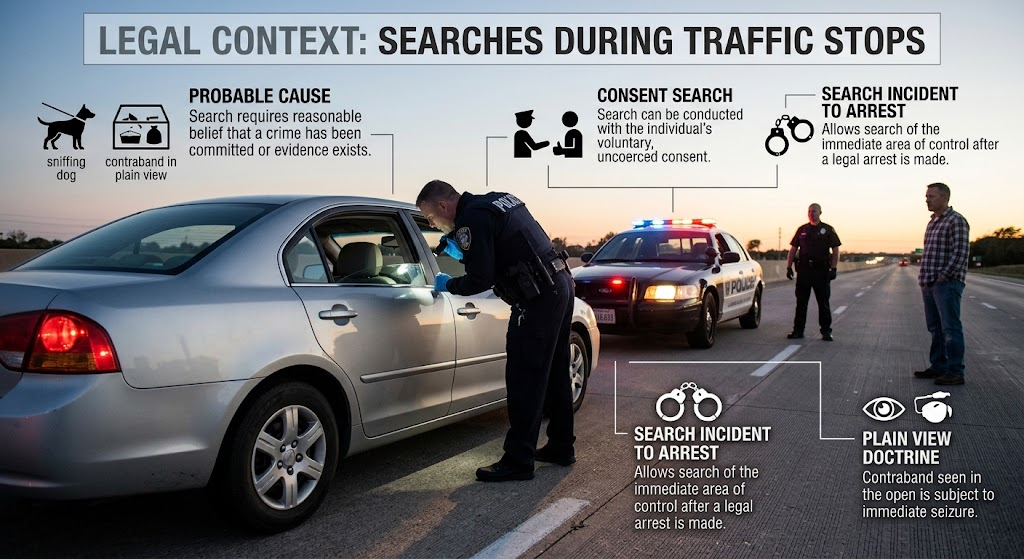
Red and blue lights in your mirror are stressful enough. Then the officer asks, “Mind if I take a look in your car?” and you have seconds to decide what to say.
So, can a cop search your car without a warrant? Sometimes yes, and sometimes no. The Fourth Amendment protects you from unreasonable searches, but courts have created several exceptions for vehicles. Knowing which ones apply, and which do not, can help you stay calm and protect your rights.
This article is general information, not legal advice. Search and seizure law is technical and varies by state, so talk to a licensed criminal defense attorney about your situation.
The Short Answer
- Police usually need a warrant to search your car.
- But there are exceptions. The most common are consent, probable cause, arrest related searches, plain view, and inventory searches.
- A traffic stop alone does not give police the right to search your whole car.
- You can refuse consent politely. Refusing is not a crime and should not be used as proof that you are hiding something.
Why Cars Get Less Protection Than Homes
Courts treat cars differently from houses. Cars are mobile, evidence can disappear quickly, and vehicles are heavily regulated. Since the Supreme Court’s Carroll v. United States decision in 1925, police have been allowed to search vehicles without a warrant in certain situations. That rule is often called the automobile exception.
Your car still has Fourth Amendment protection. It is just easier for police to justify a search than it would be at your front door.
The Six Ways a Cop Can Legally Search Your Car
Think of these as six doors. A search is generally lawful only if the officer can walk through at least one of them.
1. You give consent.
If you say yes, no warrant or probable cause is needed. Consent must be voluntary, and it can be limited or withdrawn. This is the most common way searches happen, often because drivers say yes without realizing they could say no.
2. The officer has probable cause.
Under the automobile exception, if police have probable cause to believe your car contains evidence of a crime or contraband, they can search without a warrant. Examples include the strong smell of illegal drugs, or visible evidence that links the car to a crime. The search can cover any part of the car, and any container inside it, where the item could reasonably be found.
3. The search happens after a lawful arrest.
Under Arizona v. Gant, police can search the passenger area only if you could still reach into the car at the time of the search, or if it is reasonable to believe evidence of the offense you were arrested for is inside. Once you are handcuffed and away from the vehicle, the first reason usually does not apply.
4. Evidence is in plain view.
If an officer sees illegal items from outside the car while standing where they have a legal right to be, they can seize them and often use that as probable cause to search further. Looking through the window is generally allowed. Reaching in without a legal basis is not.
5. The car is impounded and an inventory search is done.
When a car is lawfully towed, police can inventory its contents under standard department policy. The purpose is to protect property and avoid claims of theft, not to hunt for evidence, though anything illegal found may still be used.
6. The officer fears for safety.
If police have reasonable suspicion that you are armed and dangerous, they may do a limited protective search of the areas of the passenger compartment where a weapon could be hidden. This is narrower than a full search.
What Cops Cannot Do Without One of Those Six
A cop generally cannot:
- Search your trunk, glove box, or bags just because you were speeding or had a broken tail light
- Search based only on a hunch
- Search because you refused to consent
- Hold you for a long time after the stop is finished just to wait for a drug detection dog
The Traffic Stop Timeline (What Most Articles Skip)
Most guides list exceptions and stop there. In real life, your rights change at different moments of a stop. Here is a simple timeline:
Moment 1: The stop.
An officer needs reasonable suspicion of a traffic violation or crime to pull you over. A minor violation, such as a broken light or failure to signal, is often enough.
Moment 2: The ticket or warning.
Under Rodriguez v. United States, police cannot extend a traffic stop beyond the time reasonably needed to handle the reason for the stop just to conduct a dog sniff or other unrelated investigation, unless they develop new reasonable suspicion.
Moment 3: The request.
This is where many drivers lose their rights without knowing it. Officers often say, “Do you mind if I search?” Treat this as a question, not an order. You can say no.
Moment 4: The decision point.
If you refuse and the officer has no probable cause, they should let you go. If they search anyway, do not physically resist. Stay calm and let your attorney challenge it later.
What About Passengers and Their Belongings?
Under Wyoming v. Houghton, if police have probable cause to search a car, they can also search a passenger’s belongings that could hold the item they are looking for. Passengers generally can be asked to step out, and the driver can be ordered out of the car as well, under Pennsylvania v. Mimms.
Passengers also have a say. If you are a passenger, you can decline consent to a search of your own bag. But officers may still search the car if they have probable cause.
Can Police Search Your Phone During a Stop?
Generally, no. In Riley v. California, the Supreme Court held that police need a warrant to search the data on a cell phone, even after an arrest. Do not unlock your phone or hand it over unless you have talked to an attorney. Some states have additional protections.
Do Drug Detection Dogs Change Anything?
In Illinois v. Caballes, the Supreme Court said a dog sniff of the outside of a car during a lawful stop is not a search by itself, as long as the stop is not extended. If the dog alerts, that alert may give police probable cause to search. If the dog arrives after the stop should have ended, that delay can be challenged.
What Counts as Probable Cause?
Probable cause means a reasonable belief, based on facts, that a crime has happened or that evidence is in the car. It is more than a hunch. Common claims include:
- The smell of drugs
- Items in plain view
- A dog alert
- Admissions made by the driver or passengers
- Information from a reliable source
Smell is a common area of legal dispute, especially in states that have legalized marijuana. Some states now limit the use of odor alone as grounds for a search, so local law matters.
How to Respond: Calm and Clear Scripts
You do not need to argue, and you should not lie. Short, polite statements work best.
- If asked to search: “Officer, I do not consent to any searches.”
- If you want to know if you can leave: “Am I free to go?”
- If you want to stay silent: “I am going to remain silent. I would like to speak with an attorney.”
- If they search anyway: “I do not consent, but I will not resist.”
Keep your hands visible, stay calm, and follow lawful orders like handing over your license, registration, and proof of insurance.
Mistakes That Can Hurt You
- Saying yes just to be polite. Consent waives your right to challenge the search later.
- Volunteering information. Answers to questions like “Where are you coming from?” or “Is there anything illegal in the car?” can be used against you.
- Physically resisting. Even an unlawful search should be fought in court, not on the roadside.
- Lying. False statements can create new legal trouble.
- Giving consent for “just a quick look.” Once you agree, you often lose control of the scope.
- Handing over your phone. Unless there is a warrant, you do not need to unlock it.
Rights at Checkpoints and Border Areas
- Sobriety checkpoints are allowed in many states, but officers still need reasonable suspicion or probable cause for a deeper search.
- Immigration checkpoints near the border give federal agents some extra authority, but they still need probable cause or consent for a full vehicle search.
- Border crossings are different. Agents have wider power to search vehicles and belongings at the border and its functional equivalents.
What If the Search Was Illegal?
If police search your car without a valid exception, evidence they find may be thrown out under the exclusionary rule. That does not happen automatically. A defense attorney must file a motion to suppress, and the judge decides whether the search was lawful.
Do not assume that an illegal search means the case disappears. Talk to a lawyer quickly, write down what happened as soon as you can, and note badge numbers, patrol car numbers, and any body camera or dash camera details.
Do State Laws Matter?
Yes. The Fourth Amendment sets a minimum, and states can give you more protection under their own constitutions or laws. For example, some states limit consent searches, restrict odor based searches, or require officers to tell drivers they can refuse. Always check your own state’s rules.
When to Call a Criminal Defense Attorney
Speak with an attorney if:
- You were arrested after a search
- Police found something in your car and you are charged
- You believe the stop was extended without a reason
- Officers searched your phone or your passenger’s property
- You are unsure whether you consented
Many attorneys offer a free first consultation.
Final Thoughts
So, can a cop search your car without a warrant? Yes, but only under specific conditions: consent, probable cause, a lawful arrest, plain view, an inventory after impound, or a safety concern. A simple traffic stop is not enough on its own. Stay calm, stay polite, know that you can refuse consent, and never physically resist. If you believe your rights were violated, an experienced attorney can review what happened and explain your options.
FAQ
Can police search my car if I say no?
Only if they have another legal basis, such as probable cause or a lawful arrest related reason. Refusing consent cannot be used by itself as a reason to search.
Can a cop search my trunk?
Only with consent, probable cause that evidence could be in the trunk, or another valid exception. A traffic violation alone does not allow a trunk search.
Can police search my car because they smell marijuana?
In many states, they can treat the smell as probable cause, but laws are changing, especially where marijuana is legal. Check your state’s rules.
Can I be forced to get out of my car?
Yes. Officers can order drivers and passengers out during a lawful stop.
Can police keep me waiting for a drug dog?
Not if it extends the stop beyond the time needed for the traffic matter, unless they have reasonable suspicion of another crime.
Can a cop search my car at a DUI checkpoint?
A checkpoint stop alone does not allow a full search. Officers still need consent, probable cause, or another exception.
Do I have to answer questions during a stop?
You must provide your license, registration, and insurance. Beyond that, you can politely decline to answer other questions.
Should I record the stop?
In most states you may record police in public, but keep your hands visible and follow lawful orders. Check local rules.