
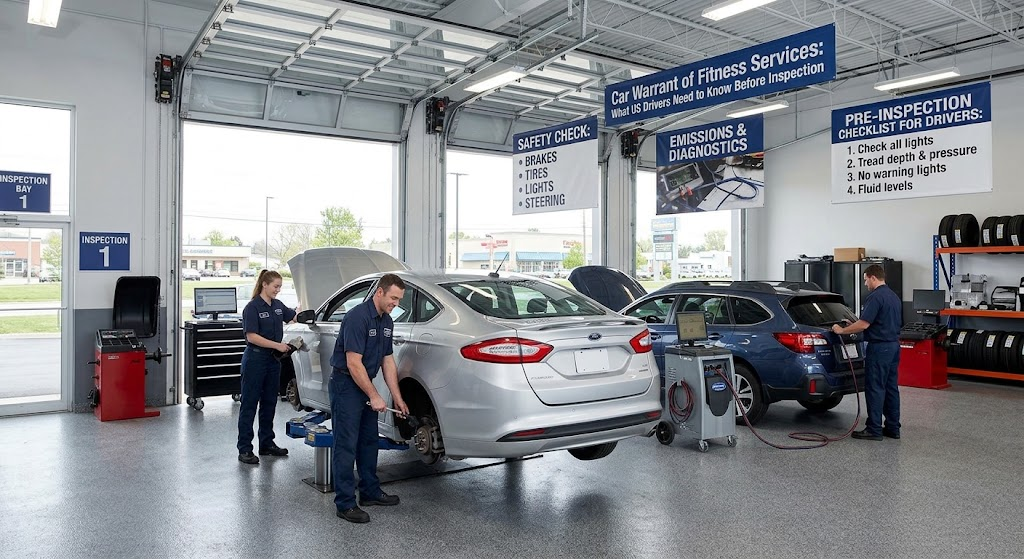
If you have searched for car warrant of fitness services, you have probably run into a terminology problem. “Warrant of fitness,” or WoF, is the term used in New Zealand for a regular vehicle safety check. In the United States, the same idea goes by other names: state vehicle safety inspection, emissions test, smog check, or roadworthiness inspection.
The goal is the same everywhere. A qualified inspector checks that your vehicle is safe and legal to drive on public roads. This guide explains how car warrant of fitness services work for US drivers, what gets checked, why vehicles fail, and how to choose a shop you can trust.
This article is general information. Inspection rules are set by each state, and sometimes by county, so always confirm current requirements with your state DMV or transportation agency.
The Short Answer
- There is no single national inspection in the US. Each state decides whether it requires a safety inspection, an emissions test, both, or neither.
- Many states require emissions testing in certain counties or metro areas, even when they do not require a safety inspection.
- A pre inspection check at a trusted shop can save you time, a failed test, and a reinspection fee.
- Commercial vehicles and fleets often face stricter rules than personal cars.
Warrant of Fitness vs US Vehicle Inspection
Here is how the terms line up in plain language:
- Warrant of fitness (WoF): A safety check showing your vehicle meets a minimum roadworthy standard. Common in New Zealand.
- State safety inspection: The closest US equivalent. Inspectors check brakes, lights, tires, steering, and other safety parts.
- Emissions or smog test: Measures exhaust output and checks the emissions system, often through the onboard diagnostics port.
- Roadworthiness check: A broader phrase used by shops, fleets, and used car buyers.
If you moved to the US from a WoF country, the process feels familiar, but the rules, fees, and frequency can be very different.
Do You Actually Need an Inspection?
Ask yourself these questions first:
- Which state is the vehicle registered in? The registration state sets the rule.
- Which county do you live in? Emissions rules often apply only in certain areas.
- How old is the vehicle? New vehicles may be exempt for a few years, and some older or classic vehicles have separate rules.
- Is the car being sold, titled, or moved to a new state? Many states require an inspection at transfer.
- Is it a commercial or rideshare vehicle? Extra requirements may apply.
- Is your registration renewal due? Many states tie inspections to renewal.
Your DMV website will give you the exact answer. Do not rely on a shop to tell you something the state does not require.
What Car Warrant of Fitness Services Typically Include
Depending on your state and the shop, a standard inspection may cover:
- Brakes: Pad and rotor thickness, brake fluid condition, parking brake, and leaks
- Tires: Tread depth, sidewall damage, tire pressure, and uneven wear
- Lights: Headlights, brake lights, turn signals, hazard lights, and license plate light
- Steering and suspension: Play in the wheel, worn joints, shocks, and struts
- Windshield and wipers: Cracks in the driver’s view, wiper condition, and washer fluid
- Mirrors and horn: Present, secure, and working
- Seat belts: Latching, retracting, and condition
- Exhaust system: Leaks, loud noise, and missing parts
- Emissions system: Check engine light status, catalytic converter, and readiness monitors
- Body and frame: Sharp edges, major rust, or structural damage
- Registration and VIN: Plate and vehicle identification number match
Why Vehicles Fail Inspection
These are the most common reasons, and most are cheap to fix before the test:
- Check engine light on. In emissions states, this is often an automatic fail.
- Worn tires or bald spots
- Burned out bulbs. The easiest and cheapest fail to avoid.
- Worn brake pads or leaking brake lines
- Cracked windshield in the driver’s field of view
- Loose or leaking exhaust
- Worn wipers
- Gas cap problems that trigger an emissions fault
- Fresh battery disconnection or recent repairs that leave readiness monitors incomplete
The Pre Inspection Walk Around (What Most Guides Skip)
Most articles tell you to “get your car inspected.” Few tell you how to arrive prepared. Spend ten minutes on this before you book:
- Turn on every light and walk around the car, or ask someone to check brake lights for you.
- Check the dashboard. If a warning light is on, diagnose it first.
- Use a coin or tread gauge to check tire tread depth, and inspect for cracks or bulges.
- Test the horn, wipers, and washers.
- Press the brake pedal. It should feel firm, not spongy, and the car should stop straight.
- Look under the car for fresh fluid leaks.
- Check the gas cap for a tight seal.
- Gather your documents: Registration, proof of insurance, and photo ID.
- Drive for at least 15 to 20 minutes before an emissions test, so the engine is warm and the monitors have had time to complete.
If you find a problem, fix it first. Passing on the first attempt saves money and time.
What Happens If You Fail
A fail is not the end of the road. Typically:
- You receive a written report listing what failed.
- You have a set period, often 15 to 60 days depending on the state, to repair and retest.
- Some states give a free or discounted retest at the same station.
- For emissions failures, some states offer repair cost waivers or assistance programs if you spend a minimum amount on repairs.
- Driving with an expired inspection sticker can lead to a ticket or fine.
Always ask the shop to explain every item on the report in plain language, and request a written estimate before approving repairs.
How Much Do Inspection Services Cost?
Fees vary widely, and in many states they are set by regulation. As a rough guide:
- State safety inspection: often a modest flat fee
- Emissions test: often a modest flat fee, sometimes free at state run stations
- Combined services: may be bundled by some shops
- Retest: often free or discounted within a time limit
- Repairs: the real cost, and the part you can control by checking things early
Ask the shop what is included, whether the fee is due even if the car fails, and whether the retest is free.
Mobile vs Shop vs Dealer Inspection
- Licensed inspection station or garage: The most common choice. Convenient and usually the lowest cost.
- Dealership service center: Good for newer vehicles and warranty work, often with higher prices.
- State run testing station: Common for emissions testing in some areas, often with short waits but no repairs on site.
- Mobile inspection services: Where permitted, a technician comes to your home or office. Great for busy drivers and fleets, but check your state allows it.
How to Choose a Trusted Inspection Provider
Look for a shop that:
- Is officially licensed or certified by your state for inspections
- Explains the report clearly and shows you the problem on the car
- Gives written estimates before any repair
- Does not pressure you into unnecessary repairs
- Has recent, honest customer reviews
- Offers a clear retest policy
- Is open about fees and wait times
Be cautious of any shop that promises a guaranteed pass, offers to skip the test for cash, or sells repairs you cannot verify. These are red flags, and in many places they are illegal.
Questions to Ask Before You Book
- Are you licensed to perform the inspection my state requires?
- What is the total fee, and is it due if my car fails?
- How long will the inspection take, and do I need an appointment?
- What is your retest policy and time window?
- Do you provide a written estimate for repairs?
- Will you return the old parts if I ask?
- Do you handle the sticker and paperwork, or do I submit it to the DMV?
Buying a Used Car: Inspection as a Safety Net
Even where no inspection is required, a pre purchase inspection from an independent mechanic is one of the smartest steps you can take. It can reveal hidden accident damage, worn suspension, brake issues, and emissions problems before you pay. A small fee upfront can protect you from a large repair bill later.
For Fleets and Small Businesses
If you manage delivery vehicles, rideshare cars, or work trucks:
- Keep a calendar of inspection and registration due dates for every vehicle.
- Schedule inspections in batches to reduce downtime.
- Keep records of every inspection and repair.
- Check whether commercial rules, such as extra safety checks, apply to your vehicles.
Final Thoughts
Car warrant of fitness services in the US come down to one thing: proving your car is safe and legal for the road. Because every state sets its own rules, start by checking your DMV requirements, do a quick pre inspection walk around, and choose a licensed, transparent shop. A little preparation can help you pass the first time, avoid fines, and keep you and others safer on the road.
FAQ
Is a warrant of fitness required in the US?
The US does not use the term, and there is no national requirement. Each state sets its own rules for safety inspections and emissions tests.
What is the US equivalent of a warrant of fitness?
The closest equivalent is a state vehicle safety inspection, often paired with an emissions or smog test.
How often do I need an inspection?
It depends on your state. Some require annual checks, some every two years, some only at sale or transfer, and some do not require them for personal vehicles.
What if my check engine light is on?
In emissions testing states, this often causes a fail. Diagnose and fix the cause before you test.
How long does an inspection take?
Many take 20 to 45 minutes, though busy stations can have longer waits.
Can I fail because of a cracked windshield?
Yes, if the crack blocks or distorts the driver’s view, depending on state rules.
Can I get my car inspected before buying it?
Yes. A pre purchase inspection by an independent mechanic is recommended, even if the state does not require one.
Do classic or new cars need inspection?
Rules vary. Some states exempt new vehicles for a few years, and some have special rules for classic or antique vehicles.