
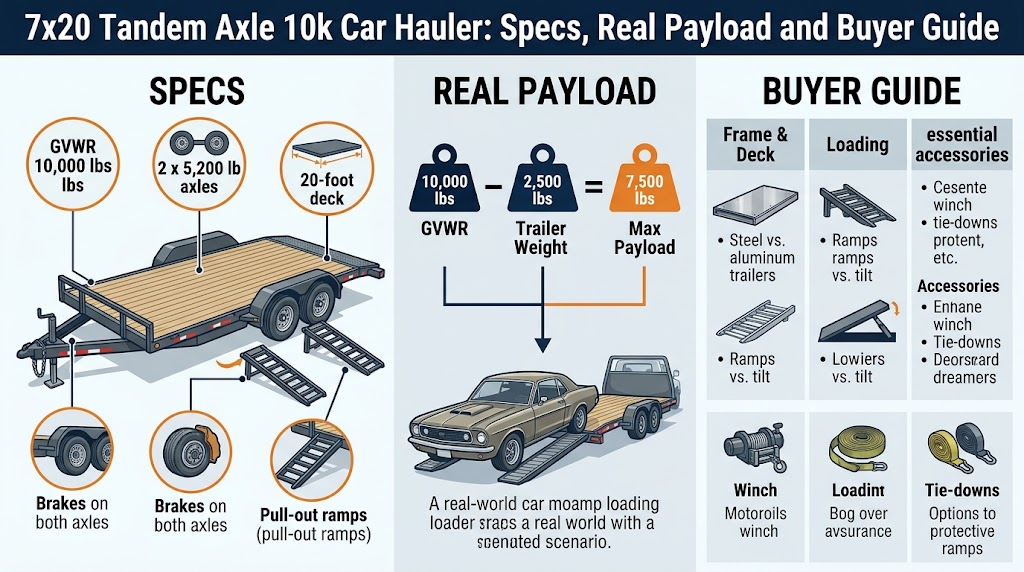
If you move project cars, race cars, or weekend vehicles, the 7×20 tandem axle 10k car hauler is one of the most popular open trailers in the US. It is long enough for most cars, light enough for many half ton and three quarter ton trucks, and rated high enough to handle daily hauling without being oversized.
But the label “10k” can be misleading. Two trailers with the same size and rating can differ a lot in usable payload, braking, build quality, and long term durability. This guide explains what a 7×20 tandem axle 10k car hauler really offers, how to calculate what you can safely carry, and what to check before you pay.
What “7×20 Tandem Axle 10k” Actually Means
- 7×20: The deck is about 7 feet wide and 20 feet long. The overall length is longer once you add the tongue and ramps.
- Tandem axle: Two axles under the trailer. This spreads weight, improves stability, and gives you a backup if a tire fails.
- 10k: The Gross Vehicle Weight Rating (GVWR), usually about 10,000 lb, and often listed as 10,400 lb when built with two 5,200 lb axles.
The GVWR is the maximum weight of the trailer plus everything on it. It is not the amount of cargo you can carry.
The Payload Math Most Sellers Skip
This is where many buyers get surprised. Use this formula:
Payload = GVWR minus empty trailer weight
A typical 7×20 open car hauler weighs roughly 2,500 to 3,200 lb empty, depending on frame size, decking, ramps, and options. That leaves about 7,000 to 7,500 lb of real payload.
Now plan for your own load:
- Vehicle weight. Use the curb weight, then add fuel, tools, spare tires, and anything inside.
- Add gear. Straps, chains, jacks, winch, and toolbox can add several hundred pounds.
- Check tongue weight. It should typically be about 10 to 15 percent of the total trailer weight.
- Compare to your tow vehicle. Your truck has its own towing capacity, payload rating, and Gross Combined Weight Rating.
Example: a 4,200 lb sedan, plus 300 lb of gear, on a 2,900 lb trailer gives about 7,400 lb total. That fits well under 10,000 lb, but your truck must be rated for it, with the right hitch and brakes.
What Fits on a 7×20 Trailer?
Good fits:
- Most sedans, coupes, and sports cars
- Classic and muscle cars
- Race cars and track cars
- Compact SUVs and crossovers
- Many half ton pickups, depending on weight and width
- UTVs, side by sides, and small equipment
Check carefully:
- Wide vehicles. The deck is about 7 feet, but fenders and rails reduce the space available for tires. Measure your tire track width, not just the body.
- Long wheelbase trucks and vans. You may need a longer deck or a different weight setup.
- Heavy, loaded pickups. They can exceed your payload quickly.
If you often haul large trucks or want extra room, consider 8.5 feet wide or a longer deck.
The Real World Fit Test (What Most Guides Skip)
Before you buy, run through this test with your own vehicle:
- Track width. Measure the outside edges of your tires, and compare to the space between fenders or rails.
- Ground clearance and approach angle. Low cars can scrape on ramps, so check the ramp angle and the deck height.
- Overhang. A longer front or rear overhang can touch the ramps or fenders.
- Winch plan. For non running cars, confirm that you can mount a winch and pull the car on straight.
- Door clearance. If you plan to open doors on the trailer, you need room.
- Balance. You should be able to place most of the weight slightly forward of the axles to keep tongue weight in range.
If the car passes all six, the trailer is a good match.
Key Specs to Look For
Frame: Look for a heavy frame, commonly 6 inch or 8 inch steel channel or I beam, with solid cross members. Ask for spacing in writing, since closer spacing handles loads better.
Axles: Two 5,200 lb axles are common on this class. Confirm they have electric brakes on both axles, not only one.
Tires: Look for load range D or E tires that match the axle rating. Check the date code on the tire, since old tires can rot even when they look new.
Brakes: Electric brakes on both axles, plus a breakaway system. Your truck needs a brake controller.
Coupler and hitch: A 2 5/16 inch coupler is typical at this weight. Make sure the hitch, ball, and draw bar are all rated for the load.
Decking: Treated wood is common and easy to replace. Steel decking is more durable but heavier and can be slippery when wet.
Ramps: Slide in ramps save space and store under the deck. Fold up or flip over ramps can be easier to use. Check their weight, the strength rating, and whether you can handle them alone.
Suspension: Leaf spring is standard. Torsion suspension gives a smoother ride on some builds.
Tie downs: Look for D rings or a track system, and enough points to secure each wheel. Quality matters more than quantity.
Lighting: LED lights and sealed wiring last longer and are easier to maintain.
Finish: A clean weld, a good primer, and quality paint reduce rust. Ask about the coating process.
Dovetail, Beavertail, or Straight Deck?
- Straight deck: Simplest and often lowest cost, but ramps are longer and angles are steeper.
- Dovetail: The rear section tilts down, which lowers the loading angle and helps low vehicles.
- Beavertail: A smooth angled rear edge, helpful for loading small equipment and cars.
If you haul sports cars or lowered vehicles, a dovetail is usually worth the money.
Towing Requirements: Can Your Truck Handle It?
A fully loaded 7×20 tandem axle 10k car hauler can reach 10,000 lb. Before you buy:
- Check your truck’s maximum towing capacity and payload rating in the owner’s manual or door sticker.
- Make sure the hitch class matches the load.
- Use a quality brake controller.
- Consider weight distribution when the load is heavy, as your truck manufacturer allows.
- Remember that braking distance, hills, and wind change with heavy loads.
A truck that can “tow 10,000 lb” on paper may not handle it comfortably in real driving.
How Much Does a 7×20 Tandem Axle 10k Car Hauler Cost?
Prices change with steel costs, region, and options. Rough ranges for new trailers:
- Basic budget build: around $5,500 to $7,000
- Mid range with better frame and finish: around $7,000 to $9,500
- Premium or heavily optioned: often $10,000 or more
Used trailers can cost less, but check the frame, axles, brakes, and tires carefully. Always ask for an itemized quote that includes freight, tax, title, and any dealer fees.
Options Worth Paying For
- Winch plate or winch mount
- Spare tire mount
- Stone guard and fenders
- Toolbox or storage
- Extra D rings or E track
- Upgraded tires
- Aluminum or heavy duty ramps
- LED light package
Skip options you will not use, but do not skimp on brakes, tires, and tie downs.
Used 7×20 Car Hauler: Inspection Checklist
- Look for frame cracks, bends, and rust, especially near welds and the tongue.
- Inspect the axles, springs, and hangers.
- Test the brakes and breakaway system.
- Check tire age, wear pattern, and load range.
- Inspect deck boards and fasteners.
- Verify the title, VIN, and weight rating plate.
- Test all lights.
- Ask about the trailer’s history, including any commercial use.
Maintenance Tips
- Check tire pressure before every trip.
- Inspect lug nuts, hubs, and wheel bearings regularly.
- Repack or service bearings per the manufacturer’s schedule.
- Test brakes and breakaway before long hauls.
- Rinse off salt and road grime.
- Touch up chips in the paint before rust spreads.
- Store with weight off the tires if the trailer sits for long periods.
Legal and Registration Notes
Rules differ by state. Check your state’s requirements for:
- Registration and title
- Brake requirements and breakaway systems
- Lighting and reflectors
- Safety chains
- Commercial use, since hauling for business may trigger extra rules such as a USDOT number, depending on weights and how you operate
When in doubt, confirm with your state DMV or transportation agency.
Buyer Checklist for a 7×20 Tandem Axle 10k Car Hauler
- What is the empty weight, and what is the real payload?
- What are the axle ratings, and do both axles have brakes?
- What tire size and load range are included?
- What are the frame size and cross member spacing?
- What type of ramps are included, and how are they rated?
- Is the deck straight, dovetail, or beavertail?
- What does the warranty cover, and who services it?
- Are freight, tax, and title included in the price?
- Can I see the trailer in person, or recent customer photos?
Final Thoughts
A 7×20 tandem axle 10k car hauler is a strong all around choice for hauling cars and light equipment, as long as you buy based on real payload, brake setup, and build quality, not only the size and the rating. Match the trailer to your vehicle and tow truck, check the details that sellers rarely mention, and you will end up with a hauler that is safer, easier to use, and lasts for years.
FAQ
How much can a 7×20 tandem axle 10k car hauler carry?
Most carry about 7,000 to 7,500 lb of payload after subtracting the trailer’s own weight, but you should check the exact empty weight and GVWR on the trailer’s label.
What size truck do I need to tow it?
It depends on the loaded weight. Many heavier half ton trucks and most three quarter ton trucks can handle it when properly equipped, but always check your manufacturer’s towing and payload ratings.
Does a 7×20 trailer fit a full size pickup?
Often it can, but width, weight, and overhang matter. Measure your truck and compare to the trailer’s usable width before buying.
Do I need electric brakes?
Yes. At this weight you need brakes on both axles, a brake controller in your truck, and a working breakaway system, and most states require them.
Is a dovetail necessary?
Not required, but it lowers the loading angle and makes loading easier for low cars.
Wood deck or steel deck?
Wood is cheaper and easy to replace. Steel lasts longer but costs more, weighs more, and can be slippery when wet.
Can I use it for business?
Yes, but business use can trigger extra rules, so check your state and federal requirements.