
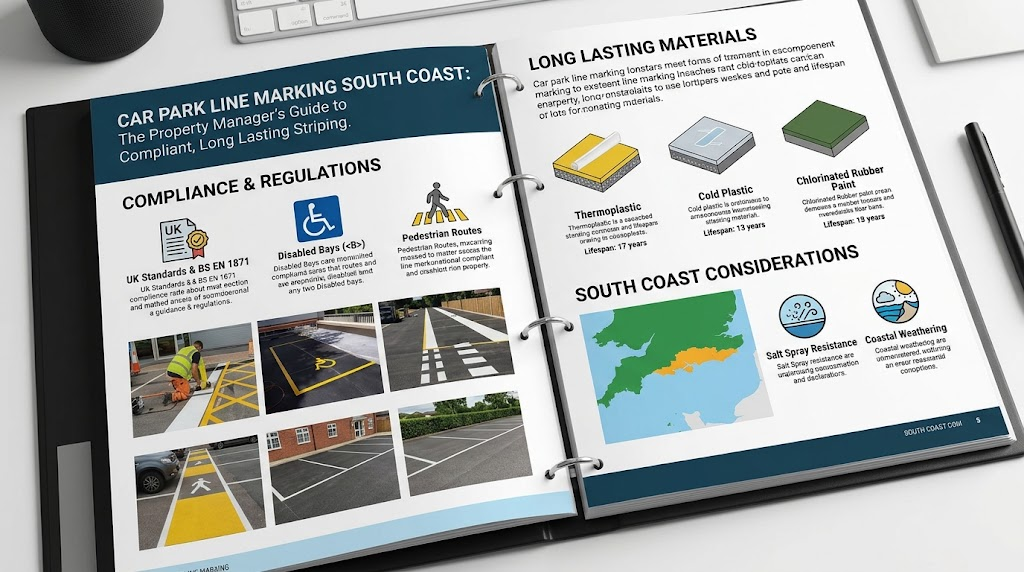
Faded lines are one of the fastest ways to make a property look neglected. They are also a liability. Unclear stalls cause fender benders, blocked fire lanes invite citations, and noncompliant accessible spaces can lead to legal complaints.
This guide covers what property managers, retailers, and facility owners need to know about car park line marking South Coast projects: what to specify, what drives cost, and how coastal conditions change the plan. If you are used to the term parking lot, you are in the right place. It is the same service.
Why Car Park Line Marking Matters More Than You Think
Line marking is easy to treat as cosmetic, but it does four jobs:
- Safety: It guides traffic flow, marks crosswalks, and keeps fire lanes clear.
- Compliance: It supports ADA accessible parking, local fire code, and municipal requirements.
- Capacity: A well planned layout can fit more usable stalls into the same footprint.
- Brand perception: Customers judge a business before they walk through the door, and the parking lot is the first thing they see.
What Makes South Coast Car Parks Different
Most generic striping guides ignore local conditions. Coastal properties face a tougher set of problems:
- Salt air and humidity speed up surface wear and can interfere with paint adhesion if the pavement is not properly prepared.
- Strong UV exposure fades pigments faster, especially bright yellows and blues.
- Sand and fine debris act like sandpaper on busy lines and hide markings if sweeping is skipped.
- Frequent moisture shrinks your application window. A reliable contractor schedules around dew, fog, and rain instead of painting over damp asphalt.
- Local environmental rules may limit which coatings you can use. In parts of Southern California, for example, air quality regulations restrict the VOC content of traffic paint, so confirm what applies to your county before choosing a product.
A contractor who understands these conditions will recommend products and timing accordingly, instead of using the same approach they would use inland.
ADA Compliance: Where Most Lots Get It Wrong
If your property serves the public, accessible parking is not optional. Under the 2010 ADA Standards for Accessible Design, key requirements include:
- Number of accessible spaces based on total parking count, with at least one in every six accessible spaces designated for vans.
- Access aisle width of at least 60 inches for standard spaces. Van spaces need an aisle of the same width plus a space at least 132 inches wide, or a 96 inch space with a 96 inch aisle.
- Level surfaces within the stall and aisle, with limited slope.
- Proper signage mounted so it stays visible, including the International Symbol of Accessibility.
- Access aisles marked and kept clear, typically with hatching, so they are not treated as extra parking.
Pavement color conventions such as blue stalls or specific hatching styles vary by state and municipality, so always verify local requirements before striping. When in doubt, ask your contractor to show you the standard they are working from.
Choosing the Right Marking Material
Water based traffic paint
Best for standard stalls, drive lanes, and most commercial lots. It has the lowest upfront cost but needs more frequent refreshing.
Solvent based paint
Best where permitted and where wear is heavier. It is more durable but faces tighter environmental limits.
Thermoplastic
Best for crosswalks, arrows, stop bars, and busy areas. It costs more but lasts much longer.
Cold plastic and epoxy
Best for specialty markings and logos. It requires specialized application.
For many coastal properties, a mixed approach works best: durable materials on high wear zones like entrances, crosswalks, and arrows, and standard paint for low traffic stalls.
The Checklist Before You Approve a Quote (What Competitors Skip)
Most striping quotes are a single line item. Before you approve one, make sure your contractor has addressed these points:
- Pavement condition. Are there cracks, oil stains, or failing asphalt that will undermine new lines? Striping over damaged pavement wastes money.
- Existing layout audit. Does the current stall count, width, and flow still make sense, or is there room to improve it?
- Compliance review. Have accessible stalls, fire lanes, and signage been checked against current standards?
- Surface prep method. Will old lines be cleaned, ground off, or painted over? Ghost lines cause confusion, especially at night.
- Product spec. Which material, and why? It should be justified by traffic and environment, not just price.
- Scheduling plan. Can work happen after hours or in phases so customers and tenants keep access?
- Cure and reopen time. When can vehicles return to each section?
If a quote does not cover most of these, you are likely comparing a price, not a plan.
What Drives the Cost of Car Park Line Marking
Rather than chasing a per stall price, understand what moves the number:
- Lot size and stall count
- Condition of existing lines (removal costs more than repainting)
- Layout changes, such as redesigning angled stalls to 90 degree stalls
- Material choice (paint versus thermoplastic)
- Number of specialty markings like arrows, symbols, stop bars, and curb painting
- Access and scheduling (night work, phased work, small mobilization jobs)
- Compliance corrections, such as adding or resizing accessible spaces
Ask for an itemized quote so you can see exactly where your money goes.
How Often Should You Restripe?
There is no universal answer, but a practical framework is:
- Busy retail, medical, and hospitality lots: inspect every 6 months and expect to refresh annually, or sooner at entrances and crosswalks.
- Moderate traffic office and residential lots: refresh roughly every 1 to 2 years.
- Low traffic lots: extend the interval, but still inspect annually.
Restripe sooner if lines are hard to see at night, accessible markings have faded, or you have resurfaced the pavement. New asphalt should be striped as soon as it is ready to receive markings.
Smart Layout Tips to Get More From Your Lot
- Standard stalls are commonly around 9 feet wide by 18 feet long, but local codes vary.
- Angled parking improves flow in one way lots, while 90 degree stalls typically fit more vehicles.
- Reserve space for EV charging, loading zones, and rideshare pickup if your tenants need them.
- Mark clear pedestrian paths so people are not walking through traffic lanes.
A layout review before painting is one of the cheapest ways to improve your property.
How to Choose a Car Park Line Marking Contractor
Look for a provider that:
- Can explain ADA and local requirements clearly
- Offers a documented site assessment, not just a quote
- Uses materials suited to coastal conditions
- Provides layout drawings or markup for larger projects
- Carries proper insurance and can supply references
- Is transparent about prep, curing, and reopening times
Final Thoughts
Good car park line marking South Coast work is about more than fresh paint. The right layout, compliant markings, and materials chosen for salt, sun, and moisture protect your customers, reduce liability, and keep your property looking professional. Start with a proper site assessment, and you will get a striping plan instead of just a price.
FAQ
How long does car park line marking take?
Most small to midsized lots can be done in a day or less, plus curing time. Larger or phased projects take longer.
Can I stripe over old lines?
Sometimes, but only if the old paint is sound. Peeling or heavily worn lines should be cleaned or removed first for a crisp, durable result.
Is ADA compliance my responsibility as the property owner?
Generally, owners and operators of public facing facilities share responsibility, so confirm details with your contractor and, if needed, a qualified accessibility consultant or attorney.
When is the best time to restripe on the coast?
Dry, mild weather with low humidity gives the best adhesion, so plan around seasonal fog and rain.