
A year ago, picking an electric van mostly meant comparing range and price. Today it also means asking whether the automaker will still be building that van in three years. Federal fleet incentives are gone, several big brands have cancelled EV programs, and a possible China rare earth deadline is weeks away.
This guide is written for fleet managers and small business owners. It explains which automakers still offer real fleet programs, who has pulled back, what the losses mean for you, and how to pick a partner who will still support your vehicles in 2030.
Information is current as of October 2026 and changes quickly. Confirm model availability, pricing, and incentive rules with the manufacturer and your dealer before you order.
The Short Answer
- Still offering electric vans and trucks to fleets: Ford (E Transit), Rivian (commercial vans), and Mercedes Benz (eSprinter), plus truck makers such as Mack, Volvo, and Freightliner in the medium and heavy duty segment.
- Exited or paused: GM ended its BrightDrop electric van program in late 2025, and Ford ended the all electric Lightning pickup.
- Federal help is gone: The commercial clean vehicle credit of up to $40,000 per vehicle ended in September 2025.
- State help is growing: California launched a $1 billion rebate program for electric medium and heavy duty trucks, with rebates of $7,500 to $120,000.
- Biggest hidden risk: Choosing an automaker whose EV roadmap could change, or whose motors depend on rare earth magnets.
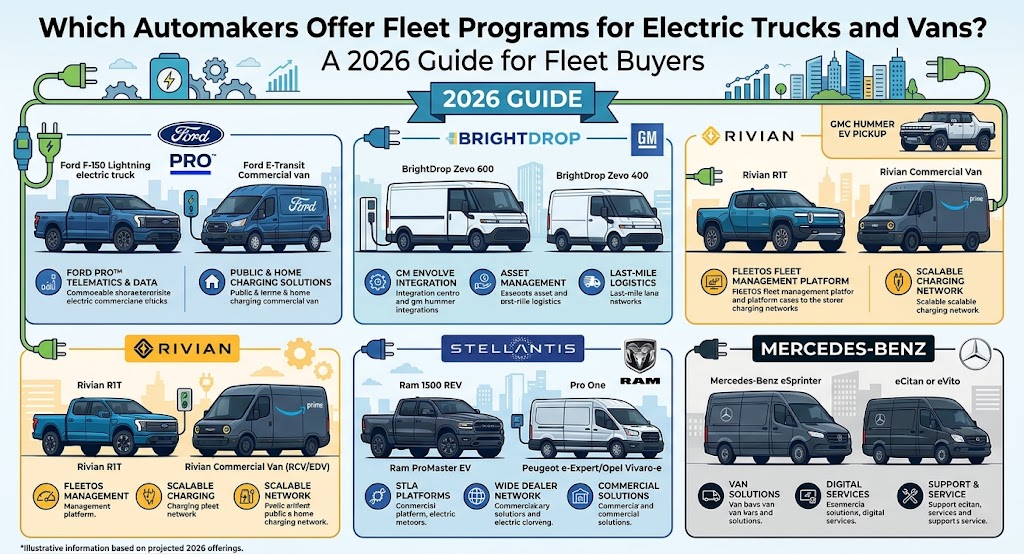
Which Automakers Offer Fleet Programs for Electric Trucks and Vans?
Here is where the main players stand for US buyers.
Ford. The E Transit remains on sale for the 2026 model year and is the most widely available electric cargo van in the US. Ford sells it through its Ford Pro business, which bundles vehicles with software, charging, and service. The catch: Ford ended the all electric Lightning pickup, and said in 2025 that its next generation electric van would arrive later than planned, around 2028.
Rivian. Rivian builds purpose designed electric delivery vans, first for Amazon, which ordered 100,000 of them. Rivian has begun selling to other fleets, with customers such as HelloFresh, Slice, and Cintas, and delivered its first van to a non Amazon fleet in early 2026. Rivian sold roughly 6,800 vans through the third quarter of 2025, more than Ford’s E Transit volume in the first half of that year.
Mercedes Benz. The eSprinter is a popular premium option for last mile and city routes. Mercedes is also moving to a new dedicated electric van platform, so ask your dealer which generation you are buying.
GM. GM ended BrightDrop production in October 2025. The company sold fewer than 5,000 of the vans in the first nine months of 2025, against a goal of 50,000 for the year. Existing BrightDrop owners should confirm parts and service plans.
Stellantis. It cancelled the all electric Ram 1500 pickup. If you are considering the ProMaster EV, confirm its current status and support directly with Ram.
Medium and heavy duty. Mack, Volvo, and Freightliner all sell electric trucks into waste, delivery, and regional hauling, where fleet use is steadiest. If your fleet carries tools and gear for job sites, it is also worth comparing the best vehicles for transporting contracting equipment.
What a Real Fleet Program Should Include
“Fleet program” can mean a discount page or a full support package. Before you count a brand as a real partner, check whether it offers:
- Volume pricing and ordering support for multiple vehicles
- Telematics and fleet software with charging data
- Charging help, from depot design to hardware partners
- Upfit support for shelving, refrigeration, and special bodies
- Service and parts coverage at dealers you can reach
- Financing, leasing, and residual value guarantees
- Battery warranty terms that fit your mileage
- A clear product roadmap in writing
If a brand cannot show most of these, treat it as a vehicle seller, not a fleet partner.
Which Automakers Have the Strongest Commitments to All Electric Lineups?
Be careful with the phrase “all electric.” Only a few brands are fully committed because they sell nothing else: Tesla, Rivian, Lucid, and Polestar.
Among traditional automakers, the pledges made in 2021 and 2022 have mostly been softened or tied to conditions. Mercedes Benz still points toward an electric future but says it depends on market conditions. BMW is investing heavily in its Neue Klasse electric platform, including about 1.7 billion euros in its Munich plant and a battery plant in Bavaria. Many other brands have shifted attention to hybrids.
For fleets, a better question than “who is all electric” is “who has paid for a long term commercial EV roadmap.” Ask for it in writing.
Which Automakers Are Cancelling Electric Vehicles Amid Shifting Consumer Demand?
The list is long. In the past year:
- Ford ended the all electric Lightning pickup, cancelled planned three row electric SUVs, and took a charge of about $19.5 billion.
- GM ended BrightDrop and reported about $7.6 billion in EV related charges in the second half of 2025, plus another $1.1 billion in the first quarter of 2026.
- Stellantis cancelled the Ram 1500 REV and took charges of roughly 22 billion euros, around $26 billion.
- Honda discontinued the launch of three electric models for North America, focusing instead on hybrids.
- Kia delayed or cut several EV models and trims.
Automakers blame weaker demand, tariffs, and the end of federal incentives. Some analysts argue the real problem was a shortage of affordable EVs, not a lack of buyers. Either way, the lesson for fleets is the same: model plans can change quickly.
Are Automakers Losing Money on Electric Vehicles?
Many are, at least on mass market EVs. Estimates of total write downs across the industry range from about $55 billion to $70 billion, depending on which companies and charges are counted. GM has said it will focus on reducing EV production costs and improving battery and vehicle design to cut its losses.
That does not mean EVs are doomed. It means weaker programs are being cut and stronger ones are being focused. For you, the risk is that a model you buy could be discontinued, leaving you with questions about parts, software updates, and resale value.
Automakers Face Billions in Losses From Cheap Off Lease Electric Vehicles
This is the story most fleet articles skip, and it is also an opportunity.
When EV tax credits were strong, many EVs were leased. Those leases are now ending, and the used vehicles are worth less than lenders expected. Analysts estimate off lease EVs may be worth about $10,000 less than forecast, with a range of $5,000 to $20,000 depending on the model. Industry losses tied to 2028 returns could approach $8 billion. Experian estimates off lease EV volume will peak in 2028 at nearly 800,000 vehicles, and EVs were expected to make up about 15 percent of off lease returns by the end of 2026.
Why fleets should care:
- Cheaper used EVs. Used electric vehicles may offer a lower cost way to start electrifying. A used 2022 Hyundai Ioniq 5, for example, has been listed from around $20,000 to $40,000 depending on trim and mileage.
- Leverage. A flood of used units can pressure new vehicle pricing.
- Residual risk. If you plan to resell your own electric vans, expect lower resale values than older forecasts suggested.
Deloitte has suggested that automakers place off lease EVs in fleet and corporate channels, so ask dealers and captive finance arms about fleet remarketing deals.
California Electric Vehicle Rebates and Automaker Matching Funds
California’s rebate plan began as a proposal and has since moved forward. The state introduced a point of sale rebate program called MyFirstEV for first time buyers: $3,500 off new EVs with a sticker price up to $50,000, and $1,750 off used EVs up to $25,000. It is backed by about $135.5 million in state funding plus matching contributions from participating automakers. Confirm which brands participate and whether the program is live in your area.
For fleets, the more useful program is the California Clean Fuel Reward, a $1 billion rebate for new electric medium and heavy duty vehicles, including box trucks and delivery vans. Rebates range from $7,500 to $120,000, and the lowest tier is limited to public fleets. It sits alongside the long running HVIP voucher program, which has delivered more than $1 billion to California fleets.
Rules, stacking limits, and eligibility are strict. Ask your dealer to confirm that the specific vehicle and your fleet qualify before you sign.
Rare Earth Magnets: The Supply Risk Behind Your Electric Van
This is where the original topic of this page fits in. Most EV motors use permanent magnets made with rare earth elements, and China dominates that supply. The International Energy Agency estimates China accounts for about 91 percent of global rare earth refining and about 94 percent of sintered magnet production.
Here is the timeline that matters now:
- April 2025: China began requiring export licenses for seven medium and heavy rare earth elements.
- October 2025: China announced a much wider set of controls, then suspended them in November 2025 for one year as part of a trade truce.
- November 10, 2026: That suspension is scheduled to expire. As of mid October, Beijing had not published a renewal, although Washington has described a short extension through January 10, 2027.
Automakers have responded by working on magnet free or low rare earth motors. BMW already uses motors without permanent magnets in several models. Renault and its supplier Valeo are targeting production around 2027. Tesla has said its next generation motors will be rare earth free, and Mercedes says its next platform uses almost no heavy rare earths. But about 95 percent of EV motors built in 2025 still used rare earth magnets, and realistic scale for alternatives is expected later in the decade.
What this means for a fleet: Ask your supplier how exposed its motors are, and whether it has secured magnet supply. A production slowdown at one automaker can delay your delivery by months.
The Fleet Partner Risk Scorecard (What Most Articles Skip)
Most guides rank vehicles by range and price. Rank automakers on risk instead. Score each brand from 1 (weak) to 5 (strong) on these eight points:
- Product continuity. Is the model in production, and is a successor planned?
- Commercial EV focus. Is the van or truck central to the company, or a side project?
- Fleet support. Telematics, charging help, upfit support, and dedicated fleet staff.
- Service network. Can a technician reach your depot within a day?
- Incentive readiness. Does the dealer know HVIP and Clean Fuel Reward rules?
- Residual value protection. Buyback, guaranteed resale, or flexible lease terms.
- Supply chain exposure. Magnet strategy, battery sourcing, and delivery timelines.
- Financial commitment. Recent EV charges, cancellations, or expansion.
A brand scoring below 24 out of 40 deserves extra questions. A brand scoring below 16 is a risk for a long contract.
Buy New, Lease, Buy Used, or Wait?
- Buy new if you have predictable routes, depot charging, and a partner that scores well on the scorecard.
- Lease if you worry about resale values or a model being discontinued, but read residual and mileage terms carefully.
- Buy used off lease if you want a lower entry cost and can accept limited warranty coverage and older technology. A used 2022 Volkswagen ID.4 is a common starting point.
- Wait if your preferred model is uncertain, incentives are pending, or the rare earth deadline could delay deliveries. Use the time to pilot one or two vehicles.
Questions to Ask Before You Sign
- Is this model confirmed in production for the next five years, in writing?
- What happens to parts and software support if the model is discontinued?
- What does the battery warranty cover, and for how many miles and years?
- Which incentives apply, and who files the paperwork?
- What is the guaranteed delivery date, and what is the penalty for delays?
- Does the motor use rare earth magnets, and what is the supply plan?
- What are the residual value and buyback terms?
- What charging support is included, and who installs the equipment?
Final Thoughts
The answer to which automakers offer fleet programs for electric trucks and vans is simple today: Ford, Rivian, and Mercedes Benz are the main options for vans, and several truck makers cover heavier work. The harder question is who will still be committed in 2030. Pick partners based on product continuity, support, and supply chain strength, not only on price and range. Use California’s rebates if you qualify, watch the November 10 rare earth deadline, and consider used off lease EVs as a low cost way to start.
FAQ
Which automakers offer fleet programs for electric vans?
Ford (E Transit), Rivian (commercial vans), and Mercedes Benz (eSprinter) are the main options in the US. GM ended its BrightDrop van program in 2025.
Is Ford still selling electric trucks?
Ford ended the all electric Lightning pickup, but still sells the E Transit electric cargo van and offers fleet services through Ford Pro.
Why are automakers cancelling electric vehicles?
They cite weaker demand, high costs, tariffs, and the end of federal incentives. Some critics say the problem was a lack of affordable EVs rather than a lack of buyers.
Are automakers losing money on EVs?
Many have reported large write downs, with industry totals estimated between $55 billion and $70 billion.
Which automakers are going all electric?
Tesla, Rivian, Lucid, and Polestar sell only EVs. Most traditional automakers now pursue a mix of electric, hybrid, and gas vehicles.
Why are automakers going electric at all?
Regulations, fleet demand, lower running costs for some uses, and competition from Chinese brands. Policy changes in the US have reduced some of that pressure.
What is the federal incentive for commercial EVs now?
The commercial clean vehicle credit of up to $40,000 ended in September 2025. State and utility programs now play a larger role.
What rebates exist in California?
The MyFirstEV program offers rebates for first time buyers, and the California Clean Fuel Reward offers $7,500 to $120,000 for electric medium and heavy duty vehicles. Check eligibility before ordering.
Why do rare earth magnets matter for EVs?
Most EV motors use them, and China controls most of the supply. A change in export rules can delay production.