
You can drive carefully for years and still have a bad day: a slick road, a parking lot scrape, or another driver who runs a red light. When that happens, the repair bill lands on someone. Collision coverage is the part of your car insurance that helps pay for your own vehicle.
This guide explains what collision coverage in car insurance is, what it covers and does not cover, how it works with your deductible, and how to decide whether you should keep it.
This article is general information, not insurance, legal, or financial advice. Policies and state rules differ, so check your own policy and talk to a licensed agent for your situation.
The Short Answer
- Collision coverage pays to repair or replace your car after it hits another vehicle or an object, or after it rolls over.
- It applies no matter who is at fault.
- You pay your deductible first, and the insurer pays the rest, up to the car’s value.
- It is optional by law, but a lender or leasing company usually requires it.
- It does not cover injuries, damage to other people’s property, or non crash events like theft or hail.
How Collision Coverage Works
When you file a collision claim, the process generally looks like this:
- You report the accident to your insurer.
- An adjuster inspects the car or reviews photos and estimates the damage.
- The insurer approves a repair cost, or declares the car a total loss.
- You pay your deductible, and the insurer pays the remaining covered amount.
If the car is repairable, the money goes toward repairs. If the cost to repair is too high compared with the car’s value, the insurer may total it and pay the car’s actual cash value, which is what the car was worth just before the crash, minus your deductible. That value may be lower than what you paid or what you still owe on a loan.
What Collision Coverage Typically Covers
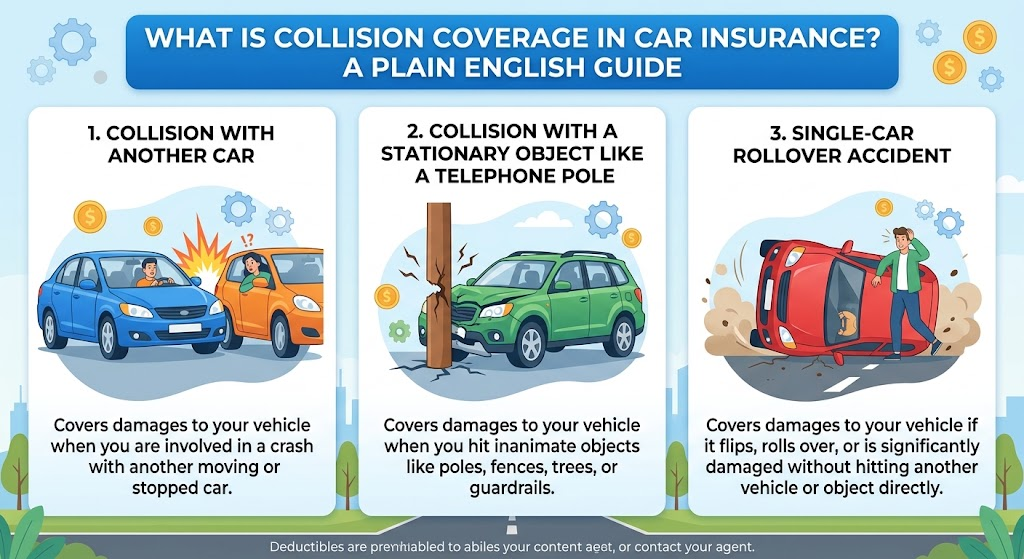
- A crash with another car, truck, or motorcycle
- Hitting a fixed object, such as a pole, fence, wall, or guardrail
- A rollover, even if no other vehicle was involved
- A single car accident, such as sliding off the road
- Damage from hitting a pothole, in many policies (check yours)
- Damage when you are at fault, or when fault is unclear
- Hit and run damage, in many cases
What Collision Coverage Does Not Cover
- Injuries to you or your passengers. That falls under medical payments, personal injury protection, or health insurance.
- Damage to other people’s cars or property. That is liability coverage.
- Theft, vandalism, fire, hail, flood, and falling objects. Those are usually covered by comprehensive insurance.
- Hitting an animal. Typically a comprehensive claim, though policies differ.
- Normal wear and tear, mechanical failure, and old damage.
- Personal items inside the car. These may fall under renters or homeowners insurance.
- A rental car or loss of use, unless you added rental reimbursement.
- The gap between your loan balance and the car’s value, unless you added gap coverage.
Collision vs Comprehensive vs Liability
Many people mix these up. Here is a simple way to see the difference:
- Collision: Your car hits something, or rolls over.
- Comprehensive: Something else happens to your car, like theft, hail, or a fallen tree.
- Liability: You hurt someone or damage their property.
You need all three ideas in mind, because each covers a different type of loss.
Do You Need Collision Coverage?
Most states do not require collision coverage. They require liability insurance instead. But you will probably need collision if:
- You have a car loan
- You lease your car
- You could not afford to repair or replace the car out of pocket
If you own an older car outright and could replace it with savings, collision may be optional.
The Collision Scenario Checker (What Most Guides Skip)
Most articles list what is covered and stop there. This quick checker helps you test real life situations. Ask yourself which coverage would pay:
- You back into a pole in a parking lot. Your collision coverage, since you hit an object.
- Another driver rear ends you. Their liability should pay, or your collision if they are uninsured or you want faster repairs, and your insurer may seek repayment from them.
- A tree branch falls on your car in a storm. Usually comprehensive.
- You hit a deer. Usually comprehensive, but check your policy.
- You hit a deep pothole and damage a wheel. Often collision, subject to your deductible.
- Your car rolls into a ditch on an icy road. Collision.
- Someone steals your car. Comprehensive.
- You rear end another car. Your liability pays for their car, and your collision pays for yours, minus the deductible.
If a scenario is unclear, call your insurer or agent before filing, because wording differs between policies.
Understanding Your Deductible
The deductible is the amount you pay before collision coverage pays the rest. Common choices run from a few hundred dollars to a couple thousand.
- A lower deductible means a higher premium but less to pay when you file a claim.
- A higher deductible means a lower premium but more to pay after a crash.
Choose a deductible you could pay tomorrow without stress. If you could not afford a $1,000 deductible in an emergency, do not pick it just to save on your premium.
A simple break even check: if raising your deductible by $500 saves you $150 a year, it takes more than three claim free years to come out ahead. Think about how likely you are to file.
What Affects the Cost of Collision Coverage
- Your car: Value, repair costs, safety features, and theft rates
- Your driving record: Accidents and tickets raise prices
- Your age and experience
- Where you live: Traffic, weather, and local repair costs
- How much you drive
- Your deductible
- Your credit based insurance score, in states where it is allowed
- The insurer you choose
Shopping around and asking about discounts, such as bundling, safe driver, and low mileage, can lower the price.
Should You Keep Collision on an Older Car?
There is no single rule, but here is a practical way to check.
- Find your car’s current market value.
- Find how much you pay each year for collision coverage.
- Add your deductible to that yearly cost.
- Compare it to the car’s value.
If the yearly collision premium plus the deductible is a large share of what the car is worth, such as a quarter or more, the coverage may not be a good deal. Many people use a rule of thumb that if the premium is about 10 percent of the car’s value, it is time to consider dropping it. Treat that as a starting point, not a rule.
Keep collision longer if you could not replace the car without it, or if you have a loan.
Will a Claim Raise Your Rates?
It can. A collision claim, especially one where you were at fault, may raise your premium at renewal, and some insurers offer accident forgiveness. Small repairs can sometimes cost less than your deductible plus the future increase. Get a repair estimate before you decide to file, and ask your agent how a claim could affect your rates.
What to Do After an Accident
- Check for injuries and call 911 if needed.
- Move to a safe place if you can.
- Exchange information with other drivers.
- Take photos of the damage, the scene, and license plates.
- Get contact details from witnesses.
- File a police report if required or helpful.
- Contact your insurer promptly.
- Keep copies of every estimate, receipt, and message.
Do not admit fault at the scene. Stick to the facts and let the insurers sort it out.
Questions to Ask Your Agent
- What is my collision deductible, and can I change it?
- How does the insurer determine my car’s value if it is totaled?
- Does my policy cover pothole damage?
- Do I have rental reimbursement, or should I add it?
- Would gap coverage make sense with my loan or lease?
- Do I have accident forgiveness?
- Will I save money if I raise my deductible?
Final Thoughts
So, what is collision coverage in car insurance? It is the coverage that pays for your own car after a crash, no matter who caused it, once you pay your deductible. It is not required by law, but it protects you from a large repair bill or the loss of your car. Choose a deductible you can afford, understand what it does not cover, and review the policy every year as your car ages. A short call with a licensed agent can help you get the right balance of protection and price.
FAQ
What does collision coverage pay for?
It pays to repair or replace your car after a crash with another vehicle or an object, or after a rollover, up to the car’s value and minus your deductible.
Does collision coverage pay if I am at fault?
Yes. Collision applies whoever is at fault.
Is collision coverage required?
Usually not by state law, but lenders and leasing companies often require it.
What is the difference between collision and comprehensive?
Collision covers crashes and rollovers. Comprehensive covers other events like theft, fire, hail, and falling objects.
How much is the deductible?
It depends on your policy. Common options range from a few hundred dollars to a couple thousand.
Does collision cover a total loss?
Yes, in most cases, the insurer pays the car’s actual cash value minus your deductible, which may be less than you owe on a loan.
Does collision coverage cover other drivers’ cars?
No. Damage to other people’s property is covered by liability insurance.
Will collision coverage cover a rental car?
Not by itself. Rental reimbursement is a separate option.
Can I drop collision coverage?
You can if you have no loan or lease and you are comfortable paying for repairs or replacement yourself.