
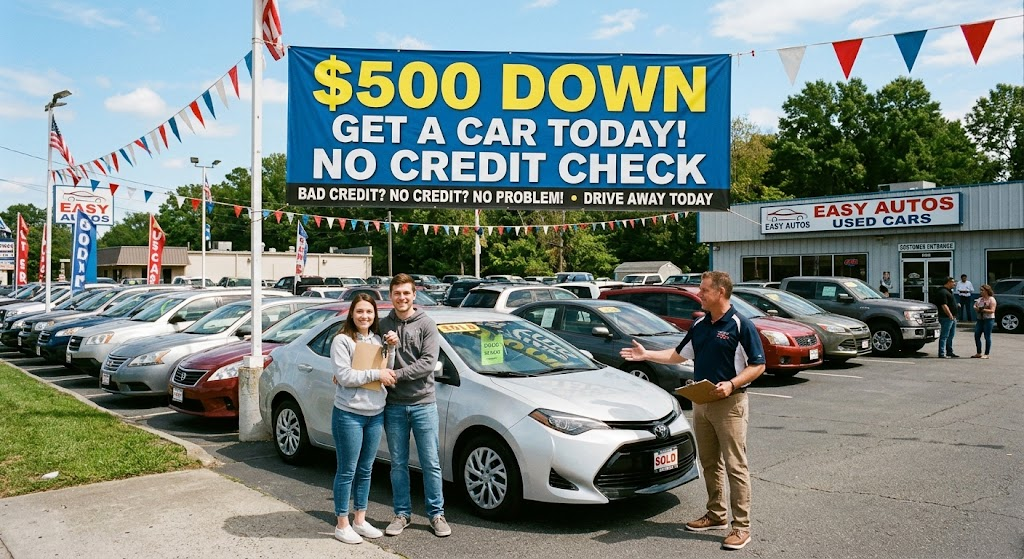
A $500 down on a car no credit check deal does exist, but it almost always comes from a buy here pay here dealer that finances the car itself instead of sending you to a bank. These lots approve people other lenders turn away, and that convenience usually comes with a high price. This guide explains how the deals work, a simple test to see whether one is worth it, and what to try before you sign.
What No Credit Check Really Means
When a dealer says “no credit check,” they usually mean your credit score will not decide the approval. They may still verify your income, your address, and your job. Some run a light credit pull, and some skip it entirely because they plan to keep control of the car until you finish paying.
In other words, the risk the bank would worry about is handled by the dealer in a different way: higher prices, higher interest, and tighter terms. Approval is easier, but the cost of that approval lands on you.
How Buy Here Pay Here Deals Work
The dealer sells you the car and lends you the money, so there is no outside lender. That brings a few features you should know about before visiting.
- Limited inventory. Cars tend to be older, with higher mileage.
- Frequent payments. Many lots ask for weekly or every two weeks payments, sometimes in person.
- High interest. Rates are often at or near the highest your state allows.
- Tracking and shutoff devices. Some dealers install GPS trackers or starter interrupt devices that can stop the car if you fall behind.
- Unclear credit reporting. Some lots do not report your on time payments to the credit bureaus, which means the loan may not help you build credit.
None of this makes every lot a bad choice. It means you need to read the terms carefully.
What They Check Instead of Credit
Expect to prove stability. Most lots ask for:
- Recent pay stubs or other proof of income
- A government issued photo ID. If you do not have a driver’s license, read about car finance with no license required before you shop
- Proof of address, such as a utility bill
- A list of personal references
- Your down payment, often in cash or by debit card
The True Cost Test
Monthly payment is the number dealers want you to focus on. A better measure is how much you will pay in total compared with what the car is actually worth.
True Cost Ratio = (Down payment + Total of all payments) divided by the car’s market value
Here is an example with round numbers. A car is priced at $9,000, but its market value is about $5,500. You put $500 down and finance $8,500 at 24% interest for 36 months. Your payment is about $333 a month, which adds up to roughly $12,005 in payments. Add the $500 down payment and you will pay about $12,505 for a car worth $5,500. Your True Cost Ratio is about 2.3.
As a rough guide, a ratio near 1.5 or lower is reasonable for a high risk loan. A ratio above 2 is a warning sign that you may be paying double. Look up the market value of the car before you agree to anything, and compare it with the price on the window.
Seven Questions to Ask Before You Sign
- What is the total price, including fees, taxes, and add ons?
- What is the interest rate, and what is the total of all payments?
- Do you report my payments to the credit bureaus?
- Is there a tracking or shutoff device in the car?
- What happens if I am late or miss a payment?
- Can I pay the loan off early without a penalty?
- Does the car come with any warranty, and can my own mechanic inspect it first?
If a dealer dodges any of these, treat that as your answer.
Protect Yourself Before You Buy
- Get an independent inspection. Ask a trusted mechanic to look at the car before you sign. The cost is small compared with a major repair.
- Run a vehicle history report. Check for accidents, title problems, and odometer issues.
- Look at the Buyers Guide. Used cars sold by dealers are supposed to display one that states whether the car comes with a warranty.
- Plan for insurance. These lots usually require full coverage, including collision coverage, for as long as you owe money, so get a quote before you commit.
- Get every document. Take copies of the contract, the payment schedule, and the title information. Never sign blank forms.
What Happens If You Miss a Payment
Buy here pay here lenders can act quickly. Depending on your state and contract, a late payment may trigger fees, a shutoff device, or repossession after a short window. If you think you may fall behind, call the dealer before the due date and ask what options exist. Waiting until after you miss the payment usually gives you fewer choices.
Better Options to Try First
Work through these before accepting a no credit check deal.
- Credit union loan. Credit unions often work with limited credit, and rates are usually lower than buy here pay here lots.
- Co signer. A person with stronger credit can help you qualify for a regular loan, but they take on real responsibility.
- Subprime lender that reports to the bureaus. Rates are higher than a bank, but on time payments can improve your score.
- A cheaper car you can pay for mostly in cash. A smaller loan or no loan is often safer than a bigger one at a high rate.
- A trade in as your down payment. If you already own a car, its value may replace the cash. Our guide to trade in value on my car shows how to find a fair number.
- A few more months of saving. A larger down payment and a few months of credit repair can change your options.
Quick Checklist
- Look up the market value of the car you want
- Run the True Cost Ratio
- Ask the seven questions in writing
- Get an inspection and a history report
- Confirm insurance requirements and cost
- Read the whole contract before signing
Frequently Asked Questions
Can I really buy a car with $500 down and no credit check?
Sometimes. It is most common on older, lower priced cars at buy here pay here lots. Expect to prove income and residence, and expect higher costs than a traditional loan.
Will a no credit check car loan help my credit?
Only if the lender reports your payments to the credit bureaus. Ask directly, and get the answer in writing.
Do I need a job to get approved?
Usually you need steady income. Some lots accept benefits or other documented income, but they will want proof.
Is $500 down enough?
It depends on the car and the dealer. Some lots will accept $500 on a lower priced car, while others ask for more. A larger down payment lowers what you borrow and the interest you pay.
Can I refinance later?
Often yes, if your credit improves and the car is still worth enough to cover the loan. Check your contract for any penalty for paying early.
Final Thoughts
A $500 down, no credit check car can get you moving when other doors are closed, but the price of that convenience can be steep. Run the True Cost Ratio, ask the seven questions, and compare the deal with the alternatives before you sign. A few days of homework can save you thousands of dollars over the life of the loan.